

Book
Blogs
- Adolf Hitler learns about AI
- Why do many people support Donald Trump?
- Iran Conference, 14 July 2026
- Victim impact statements are much abused
- Psychological Ability to Deceive!
- Trump is doing in Iran what Putin did in Ukraine”, says former head of British spy agency M16
- Trump officials asked: “Why Australian Jews aren’t carrying guns”
- Iran’s military defeat could echoe the 1920s-30s in Germany and Russia in the 1990s and early 2000s.
- AFR article about Greg Moriarty
- Jo Tarnawsky on Richard Marles USA Obsession!
- Muslims Should Not Trust Australian Courts!
- Why ICE agents continue shooting & shooting!
- Appointment of Greg Moriarty as Ambassador to the USA will damage Australia’s national security.
- Trump will Not give up Power – A Scenario!
- Cognitive blind spots
- AUKUS and Kim Jong Un
- David Gonski and Chris Minns
- Video on secret origins of AUKUS
- Peter Jennings would thrive in an authoritarian country.
- David Leser, a Jewish author & journalist, wrote:
- My 31 year Russian Saga
- Actor Russell Crowe: Hermaan Goring in Nuremberg
- “Foreign Affairs” magazine nonsense on AUKUS
- How China Can Succeed in Taking Control of Taiwan Under Trump!
- Trump Psychology and Capability compared to Famous Dictators
- Video of Putin’s Psychology and Leadership Style
- Trump’s Security Adviser Stephen Miller & Himmler-Bormann
- Video (and Text) comparing Putin’s rise and consolidation of power to other historical dictators
- ASIO chief Mike Burgess would be happy working for Putin
- Australia’s Racist NSW Police
- Trump’s Odessa for Greenland deal!
- Confidential Letter to Trump on AUKUS
- Why Do People Serve a Donald Trump and Vladimir Putin?
- Trump Psychology and Capability compared to Famous Dictators
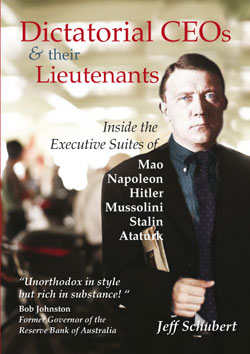
- Putin and his Lieutenants compared to Mao, Napoleon, Hitler, Mussolini, Stalin and Ataturk
- Russian Censorship Comes to Australia via Jews!
- Anne Applebaum writes like Trump talks
- Putin’s Successor if he is killed soon!
- Brittany Higgins false rape earned her $2m
- Lies of Mike Burgess, the Director General of ASIO
- Beazley, Richardson, Dibb are old men pushing sexy, ignorant group thinks.
- Jewish women Yvonne Engelman and Nina Bassat are Russia-type PR pawns?
- Bad News for Ukraine
- Group Think psychology of AUKUS and Option 2
- Putin says he follows Israeli Gaza example
- Henry Ergas praises Nazi “Will”
- What did we learn from the Tucker Carlson interview of Putin?
- Russian-Ukraine lessons on China
- Me and Colin Rubenstein – an Australian “traitor”?
- Cardinal Pell and David McBride
- Air Chief Marshal Houston & Hitler
- Albrechtsen plagiarises Goebbels
- Anatoly Chubais
- Assange and Defence
- Blair & Gadhafi
- Blair & Napoleon
- Brooks and Tett on policy psychology
- Cardinal Pell’s God
- Donald Rumsfeld
- Field-Marshal Keitel
- George Bush, Stalin, Mao
- Gillard & Duncan Lewis
- Gillard & Obama
- Gillard & Putin
- Gillard: psychological profile
- Gillard’s personal decision UN vote!
- Goering’s Wisdom
- History of anti-terrorist laws in dictatorships
- Howard & Sinodinos
- James Packer’s lieutenants
- Lateral Thinking
- Lawyer X, Huawei, National Security, Scott Morrison, Chinese in Australia!
- Major-General Cantwell & Matiullah Khan
- Medvedev & Obama
- Medvedev & Putin: “power corrupts”
- Morrison, Binskin and Napoleon
- National Security Myth
- Obama, Jefferson, slaves, murder, Nobel Prizes
- Obama’s Nobel Prize speech
- Paul Lodge (Family Court, Australia)
- Peta Credlin and Abbott, like Hitler-Bormann
- Peter FitzSimmons, George Pell, bias and group think.
- Psychologies of Putin and USA
- Psychology of Secret Courts / Military Tribunals
- Psychology of Supporters of Bush & Saddam
- Putin in 2000
- Putin Personality Cult
- Putin, Gillard, Abbott, Medvedev
- Putin: New Faces and Flaws in the Weave
- Putin’s dangerous reading
- Russia, NATO, Missile Defence
- Tony Abbott
- US Missile Defence
- Wendi (Wendy) Deng
- Why I support WikiLeaks
- Movie Script: Russia to Cambodia
Personal Links
Cognitive Blind Spots
Gillian Tett wrote in Financial Times (2 January 2026) that the Swiss Federal Intelligence Service (FIS) has published a manual about “cognitive blind spots” which says: “Many people have little to no knowledge of how human thinking works”.
Here I use several Tett examples to consider Trump’s cognitive blind spots in foreign policy.
Group think (“adhering to the cosy assumptions of our tribe”)
Trump has now surrounded himself with enthusiastic “yes” officials who compete in their shows of devotion. This makes group-think inevitable. Trump supporters would argue that everyone is focussed on the same goals and thus make success more likely. However, group think can lead to major mistakes (such as the invasion of Iraq in 2003).
Anchoring (“relying exclusively on whatever information we see first, say on social media”)
Trump is notorious for changing his public utterances on issues, but it is unclear to what degree his basic view – which he will mostly come back to – is determined by what information he first heard or saw.
Confirmation bias: (“only seeing data that reinforces pre-existing views”)
Trump will always seek information that reinforces his existing views irrespective of whether they are a result of “anchoring”. We see this in his dealings with Vladimir Putin which reflects his view of a special relationship with certain strong personalities.
Mirror imaging (“assuming others think like us”)
Trump assumes that leaders of other countries are driven mainly by money and personal vanity. Trump seems incapable of understanding things like nationalism even as he claims that he is working to make the USA “great” again mainly based on financial and business aspects of tariffs. Trump’s personal vanity, rather than any understanding of defence technology and its capabilities, is the driving the idea of a “Trump-class battleship” and “Golden Dome” missile defence system.
Absence of evidence (“failing to think about the data we lack”)
In a narrow business sense in a specific industry, such as real-estate, this may not be a major disadvantage, but in international relations it is a recipe for disaster. Trump’s claim that the US would “run” the government of Venezuela after the overthrow of Nicolas Maduro reflected an absence of knowledge of the complexities of such a task.
“Survivor bias: (“judging data only with success stories, not failures”)
Trump has had many notable successes as president, including reduced fighting in a number of places like Gaza, bombing of Iran, and the capture of Maduro. These successes are not the result of intrinsic Trump talents but are the result of existing US financial and military power. Trump mostly defines success in PR terms and the risk is that he will increasingly see himself as a genius in foreign policy — and will disregard more cautious voices!
My report, “Trump Psychology and Capability compared to Famous Dictators”, can be read here:
https://www.jeffschubert.com/trump-as-ceo-compared-to-famous-dictators/