

Book
Blogs
- Anthony Albanese sucks Siobhan McKenna
- Australia’s Biggest Enemy are its Military Generals and Admirals!
- Would China attack US aircraft carrier strike group to defend against AI attack?
- Adolf Hitler learns about AI
- Why do many people support Donald Trump?
- Iran Conference, 14 July 2026
- Victim impact statements are much abused
- Psychological Ability to Deceive!
- Trump is doing in Iran what Putin did in Ukraine”, says former head of British spy agency M16
- Trump officials asked: “Why Australian Jews aren’t carrying guns”
- Iran’s military defeat could echoe the 1920s-30s in Germany and Russia in the 1990s and early 2000s.
- AFR article about Greg Moriarty
- Jo Tarnawsky on Richard Marles USA Obsession!
- Muslims Should Not Trust Australian Courts!
- Why ICE agents continue shooting & shooting!
- Appointment of Greg Moriarty as Ambassador to the USA will damage Australia’s national security.
- Trump will Not give up Power – A Scenario!
- Cognitive blind spots
- AUKUS and Kim Jong Un
- David Gonski and Chris Minns
- Video on secret origins of AUKUS
- Peter Jennings would thrive in an authoritarian country.
- David Leser, a Jewish author & journalist, wrote:
- My 31 year Russian Saga
- Actor Russell Crowe: Hermaan Goring in Nuremberg
- “Foreign Affairs” magazine nonsense on AUKUS
- How China Can Succeed in Taking Control of Taiwan Under Trump!
- Trump Psychology and Capability compared to Famous Dictators
- Video of Putin’s Psychology and Leadership Style
- Trump’s Security Adviser Stephen Miller & Himmler-Bormann
- Video (and Text) comparing Putin’s rise and consolidation of power to other historical dictators
- ASIO chief Mike Burgess would be happy working for Putin
- Australia’s Racist NSW Police
- Trump’s Odessa for Greenland deal!
- Confidential Letter to Trump on AUKUS
- Why Do People Serve a Donald Trump and Vladimir Putin?
- Trump Psychology and Capability compared to Famous Dictators
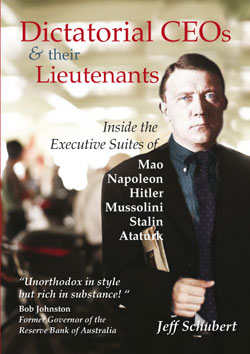
- Putin and his Lieutenants compared to Mao, Napoleon, Hitler, Mussolini, Stalin and Ataturk
- Russian Censorship Comes to Australia via Jews!
- Anne Applebaum writes like Trump talks
- Putin’s Successor if he is killed soon!
- Brittany Higgins false rape earned her $2m
- Lies of Mike Burgess, the Director General of ASIO
- Beazley, Richardson, Dibb are old men pushing sexy, ignorant group thinks.
- Jewish women Yvonne Engelman and Nina Bassat are Russia-type PR pawns?
- Bad News for Ukraine
- Group Think psychology of AUKUS and Option 2
- Putin says he follows Israeli Gaza example
- Henry Ergas praises Nazi “Will”
- What did we learn from the Tucker Carlson interview of Putin?
- Russian-Ukraine lessons on China
- Me and Colin Rubenstein – an Australian “traitor”?
- Cardinal Pell and David McBride
- Air Chief Marshal Houston & Hitler
- Albrechtsen plagiarises Goebbels
- Anatoly Chubais
- Assange and Defence
- Blair & Gadhafi
- Blair & Napoleon
- Brooks and Tett on policy psychology
- Cardinal Pell’s God
- Donald Rumsfeld
- Field-Marshal Keitel
- George Bush, Stalin, Mao
- Gillard & Duncan Lewis
- Gillard & Obama
- Gillard & Putin
- Gillard: psychological profile
- Gillard’s personal decision UN vote!
- Goering’s Wisdom
- History of anti-terrorist laws in dictatorships
- Howard & Sinodinos
- James Packer’s lieutenants
- Lateral Thinking
- Lawyer X, Huawei, National Security, Scott Morrison, Chinese in Australia!
- Major-General Cantwell & Matiullah Khan
- Medvedev & Obama
- Medvedev & Putin: “power corrupts”
- Morrison, Binskin and Napoleon
- National Security Myth
- Obama, Jefferson, slaves, murder, Nobel Prizes
- Obama’s Nobel Prize speech
- Paul Lodge (Family Court, Australia)
- Peta Credlin and Abbott, like Hitler-Bormann
- Peter FitzSimmons, George Pell, bias and group think.
- Psychologies of Putin and USA
- Psychology of Secret Courts / Military Tribunals
- Psychology of Supporters of Bush & Saddam
- Putin in 2000
- Putin Personality Cult
- Putin, Gillard, Abbott, Medvedev
- Putin: New Faces and Flaws in the Weave
- Putin’s dangerous reading
- Russia, NATO, Missile Defence
- Tony Abbott
- US Missile Defence
- Wendi (Wendy) Deng
- Why I support WikiLeaks
- Movie Script: Russia to Cambodia
Personal Links
Trump Psychology and Capability compared to Famous Dictators
A. Introduction
Timothy Snyder, the historian, and many others believe that Donald Trump is taking the USA to a dictatorship. This article aims to address this issue by comparing the psychology and capability of Trump and his “executive team” with Josef Stalin (from 1924 to 1953); Napoleon Bonaparte (1799 to 1814), Benito Mussolini (1922 to 1943), Adolf Hitler (1933 to 1945), Mao Zedong (1949 to 1976) and Kemal Ataturk (1923 to 1938) and their executive teams. The focus is not on policy or morality but on attitudes to, and ability, in the use of power.
B. Road to Power
C. Aims
D. PR / Communication / Actor
E. Personality
F. Intuition / Knowledge / Decision Making
G. Self-belief / Doubts
H. Influence and Manipulation
(1) Psychology of Influencing Trump
(2) Psychology of Trump Influencing Others
(3) The Special Role of Money
I. Admitting Mistake / Being Wrong
J. Grievances
K. Trump’s Executive Team
B. Road to Power
In March 2023 Donald Trump addressed the Conservative Political Action Committee Conference, saying: “In 2016, I declared: I am your voice. Today (in 2023), I add: I am your warrior. I am your justice. And for those who have been wronged and betrayed: I am your retribution.”[1]
Similarly, Hans Frank, a Nazi lawyer and later Governor-General of Poland, described what he thought was “the secret of Adolf Hitler’s power”: “He stood up and pounded his fist, and shouted, ‘I am the Man!’ – and he shouted about his strength and determination – and so the public surrendered to him with hysterical enthusiasm.” Hitler was matching his talents with the times. A decade earlier the First World War had ended with Germany signing the punitive Treaty of Versailles. Not only was it financially harsh, but it excoriated national pride. After Rudolf Hess, Hitler’s secretary, first heard Hitler speak he was excited: “A man – I’ve heard a man, he’s unknown, I’ve forgotten his name. But if anyone can free us from Versailles, then it’s this man. This unknown man will restore our honour.”
Journalist David Brooks says that “all his life” Trump “has moved forward with new projects and attempted new conquests, despite repeated failures and bankruptcies that would have humbled a non-narcissist.”[2]
Emil Ludwig, the writer who met and interviewed Benito Mussolini, Josef Stalin and Kemal Ataturk, wrote about the role of determination in accumulating power: “It is undoubtedly true that the men Mussolini set out to overthrow were weaker than he. That is no proof of the rightness of his idea, but only the strength of his personality.” Ludwig went on to say that Mussolini’s “self-confidence” represents “half his success”.
Journalist Mark Halperin and ex-politician Newt Gingrich have discussed how Trump’s “alpha male” energy helps him politically.[3] Journalist David Brooks has written about a “vitality gap” between Trump and his opponents.[4]
Turkish feminist and nationalist Edibe Halide wrote: “Of course, one knew all the time that there were men around him (Kemal Ataturk) who were greatly superior in intellect, and far above him in culture and education. But though he excelled them in neither refinement nor originality, not one of them could possibly cope with his vitality. Whatever their qualities, they were made on a more or less normal scale. In terms of vitality he wasn’t. And it was this alone that made him the dominant figure.”
Trump was widely admired for his defiant reaction when a potential assassin’s bullet missed his head by a fraction of an inch and clipped his ear. In 1926 an unbalanced foreigner took a shot at Benito Mussolini, but only nicked the bridge of his nose. In an example of indirectly providing inspiration to his lieutenants – as well as the general population as did Trump – Mussolini continued to work that day wearing a small plaster on his nose and gave several speeches. In one he said: “I am one of your generation. That means that I am the newest sort of Italian, one who is never thrown by events, but rather proceeds always straight down the road assigned by destiny.”
Trump’s has had a number of successes in 2025 – in foreign policy and domestically — which have boosted his power. Many Trump opponents have become afraid. The Financial Times has reported Lisa Murkowski, “the Republican senator least aligned with Trump”, as saying: “We’re all afraid. I’m often very anxious myself about using my voice because retaliation is real.” Her fear enabled Trump’s bill to pass by one vote.[5]
Louis Bourreinne, Napoleon Bonoparte’s first secretary and child-hood friend, later wrote about such accumulation of power: “Without any shock, and in the short space of four years, there arose above the ruins of the short-lived Republic a Government more absolute than ever was Louis XIV’s. (While) this extraordinary change is to be assigned to many causes. I had the opportunity of observing the influence which the determined will of one man exercised over his fellow men.”
Trump, in 2025, seems to have the same effect on much of the USA population as Napoleon’s Minister of Navy, Denis Decres, recalled: “Napoleon “enslaved us all” because “he held our imagination in his hand, sometimes a hand of steel, sometimes a hand of velvet; one never knew how it was going to be from day to day, so that there was no means of escaping.”
C. Aims
General Armand de Caulaincourt, a close aide to Napoleon Bonaprte, later wrote that “France and Emperor (Napoleon) were blended in glory which had become common to both.” Similarly, Trump continually equates his own greatness with American greatness, but which is the primary goal? Trump greatness or American greatness?
Journalist and commentator Bill O’Reilly has known Trump for many years and often communicates with him. O’Reilly says that Trump “lives to win” and that “he is the most competitive person I have ever met.” “He separates winners from losers and he wants to associate with winners and he wants to be a winner.” “His whole life is about accomplishment.”[6]
Historian and commentator Nial Ferguson says that Trump’s “utility function is basically to lead the news every day and the fact that we’re talking about him now means he’s winning because that’s how really Trump defines success”[7] Mao Zedong’s long-time doctor, Li Zhisui, later wrote that Mao was similar and needed to be reassured: “His life depended on the admiration of others. He craved affection and acclaim.”
But Mao Zedong also had other goals to accomplish besides fame! Dr. Li also wrote that Mao insisted “on policies that no one else had ever imagined, dangerous, risky policies like the Great Leap Forward, the people’s communes, and the Cultural Revolution, all of which were designed to transform China”.
So, does Trump have any other aims other than to “lead the news every day”? Bill O’Reilly says that Trump is “he’s very interested in his legacy. He wants to be on Mount Rushmore (along with George Washington, Thomas Jefferson, Theodore Roosevelt and Abraham Lincoln) and he’ll buy another Mountain to put himself on it if he has to”.[8]
Biographer Maggie Haberman interviewed Trump several times and on one occasion, after his first stint as president, he told her that “the question I get asked more than any other question: If you had it to do again, would you have done it?” Trump then answered the question himself: “The answer is, yeah, I think so. Because here’s the way I look at it. I have so many rich friends and nobody knows who they are.” Haberman wrote that Trump “went on to talk about how much easier life would have been had he not run. Yet there it was: reflecting on the meaning of having been president of the United States, his first impulse was not to mention public service, or what he felt he’d accomplished, only that it appeared to be a vehicle for fame, and that many experiences were only worth having if someone else envied them”.[9]
So, what strategy – apart from fame — does Trump have for getting on Rushmore? Trump has not said this, but he might instinctively imagine that his path to Mount Rushmore is similar to Mussolini’s view in 1917 when he was editor of the newspaper Popolo d’Italia. Mussolini wrote that Italy needed “a man who has when needed the delicate touch of an artist and the heavy hand of a warrior. A man who is sensitive and full of will-power. A man who knows and loves people, and who can direct and bend them with violence if required.”
But this still leaves the question of to what end such a “warrior” would use “violence”?
Trump would claim that he wants to “transform” the USA by bringing back manufacturing industries to America and stopping illegal immigration. But will this get him on Mount Rushmore? Bill O’Reilly has said that “uniting the country” is “not a main concern” of Trump because “he thinks that the people who hate him are not worth uniting”. He does not want to exclude anybody” but “wants to please his MAGA political base”. This sounds similar to what a British Ambassador said of Benito Mussolini: “His first consideration is Mussolini, his second is the fascist regime, his third Italy”.
Nial Ferguson says: “I remember Henry Kissinger saying to me once after he had met with Trump the president, that he has no strategic concept. Trump is a transactional individual with only a vague idea of any strategic concept”.[10]
Michael Wolff, who has written extensively about Trump says: “A longtime New York acquaintance, offered the observation that what excites Trump most is not the fire but the clanging fire engines and sirens rushing to the scene. The drama, the conflict, the sound and fury of it all.”[11] In other words, the desire to be continually part of the news of the day’s action without really knowing for what strategic purpose.
Trump’s White House Chief of Staff, Susie Wiles, says he is a “voracious reader” and lists the “New York Post cover”, Wall Street Journal, New York Times and “sometimes the Washington Post”, Financial Times and “all of the periodicals”. She then adds: “So you if you if you read the day’s newspaper, the day’s news, you can almost predict what the day is going to bring. And that is on top of whatever was supposed to be going on that day, too.”[12]
There obviously needs to be a balance but Wiles’ words are consistent with a Trump personality that is very focused on news events of the day and how he can become part of them in some way – with little idea of a “strategic concept” of why!
So, we seem to be left with the conclusion that Trump views fame and being in the news everyday as the main way of being viewed in the same way as Napoleon wanted the French to view him. According to his brother, Joseph, wrote, Napoleon “wants the need for his existence to be so direly felt, and as such a great boon, that anybody would recoil at any other possibility.” In Trump’s mind, this might eventually lead to Rushmore!
The next section covers Trump’s way of communicating with people – and particularly a larger audience. It may also contain a partial answer to the question posed in this section. Bill O’Reilly says that Trump got “well known” as a result of the 14 years reality television show The Apprentice.[13] “He was not a politician yet but after a while he got a little bored with it and so he decided to up the game again”[14] – to try to become the commander-in-chief president of the USA?
Mussolini’s Foreign Minister and son-in-law, Galeazzo Ciano, noted in his diary in 1939: “As usual with Mussolini, when he has obtained something, he always asks for more.” And, referring to Napoleon, Louis Bourreinne wrote: “His inordinate ambition goaded him on to the attainment of power; and power when possessed served only to augment his ambition.”
D. PR / Communication / Actor
Journalist and commentator Mark Halperin says that Trump “understands the media as well as any politician I’ve ever covered”[15]— with ex-politician Newt Gingrich adding that Trump thinks “any media beats no media and bad media is better than no media.”[16]
Trump biographer Michael Wolff says: “Think of Trump as a showman, or even more to the point, an actor. Most actors have an instinct for the audience and that’s exactly what Trump plays to. It’s important to remember that Donald Trump was the star of a hit reality show – The Apprentice.’’[17] Biographer Maggie Haberman wrote: “Trump cast himself in The Apprentice as he preferred to be seen — a take-charge billionaire in a leather-backed seat.[18] Bill O’Reilly says that The Apprentice years were “perfect for Trump: Trump’s in charge; Trump’s making decisions; they’re all trying to please Trump. It could not have been better for him.”[19]
According to Michael Wolff: “Trump just goes for the conflict. He understands that it is a great television and then will give him the headlines and make him the center of attention.”[20] Wolf says “Trumpian politics is an act of cruelty — he’s a deranged comic with a rapt audience.”[21] Haberman wrote that a ”core tenet of the Trump political movement has been finding publicly acceptable targets to serve as receptacles for preexisting anger. That anger helped signal his supporters, who are bound to him more by common enemies — liberals, the media, tech companies, government regulators — than shared ideals.”[22]
Wolff says that Trump “has extraordinary, nuanced appreciation of how people are reacting to him like an actor — always scanning the crowd looking for that point of connection. When you go to Trump’s rallies, which if you read them seem incoherent, you see him throwing out things looking for the response and then when he gets the response he wants, he just keeps repeating that line and keeps getting that response – actually, it sort of grows! This is a level of Genius especially for somebody functioning in this media time of ours but it certainly doesn’t involve the more conventional craft of politics — policy legislative agenda! All that is really extraneous, if not irrelevant, to Trump.[23]
Trump’s talent is similar Italy’s Benito Mussolini who was a master communicator. A journalist wrote of a 1921 speech by Mussolini: “He is a most expert orator, master of himself, who before his public always assumes the mien which best suites his subject and the moment.” Over two decades later the very experienced Mussolini said “the extent of credulity which can be found in any man of whatever class or intelligence is quite extraordinary”; “lies always win against the truth”.
Albert Speer, Hitler’s architect and later Armaments Minister, was surprised at the appearance of Hitler when he saw him for the first time in January 1931 as he addressed students of Berlin University and the Institute of Technology: “On posters and in caricatures I had seen him in military tunic, with shoulder straps, swastika armband, and hair flapping. But here he was wearing a well-fitted blue suit and looking markedly respectable. Everything about him bore out the note of reasonable modesty.” But the next time that Speer saw him, the audience – and the clothes – were different. Now he presented the image of ‘a Man’ who would not be swayed from his purpose. “I saw Hitler reproving one of his companions because the cars had not yet arrived. He paced back and forth angrily, slashing at the tops of his high boots with a dog whip and giving the general impression of a cross, uncontrolled man who treats his associates contemptuously. This Hitler was very different from the man of calm and civilised manner who had so impressed me at the student meeting. I was seeing an example of Hitler’s remarkable duplicity – indeed, ‘multiplicity’ would be a better word. With enormous histrionic intuition he could shape his behaviour to changing situations in public.”
Even as he plays to the crowd Trump may sometimes actually believe – even if temporarily – some of the more outrageous things he says. Yugoslav politician Milovan Djilas, who closely observed Stalin at the dinner table after the end of the war, wrote that his “pretence was so spontaneous that it seemed he himself became convinced of the truth and sincerity of what he was saying. He very easily adapted himself to every turn in the discussion of any new topic, and even to every new personality.”
Trump biographer Maggie Haberman wrote that Trump is “the most disciplined undisciplined person I’d ever covered, using repetition to drive home a message as the throughline of his public commentary.”[24] Haberman says that Trump is “guided by a belief in repetition; over and over he would convey to employees and friends a version of the same idea: if you say something often enough, it becomes true.”[25]
Adolf Hitler claimed he had “the gift of reducing all problems to their simplest foundations”.
Trump is similar. Bill O’Reilly says Trump approach is “keep your message simple and entertaining, don’t be boring but don’t get too complex. He’s going to fix the border. He’s going to boost your wallet. He’s going to get China. He’s going to get the stuff that people can react to; always get a reaction!”. “He’s not in the same universe as 95% of American politicians because he doesn’t think if I say this that will happen. I’m going to say what I want and I don’t give a fig.”[26] Newt Gingrich adds that Trump is “clearly a vaudeville performer and part of that, I think, is a deliberate message — how can you really be afraid of me I’m just this funny guy!”[27]
O’Reilly says that Trump “certainly wants to rattle their cages – to use a cliché; he wants to shake them not just his political opponents but foreign leaders in the media. He likes to be a provocator because it’s not boring — it’s exciting!”[28] “Trump feels that he has to entertain his audience as well as put forth his point of view on various issues so that’s why he says all this wild stuff.”[29] In a sense, this is the “clanging fire engines and sirens” fixation described by Michael Wolff discussed earlier.
Maggie Haberman wrote that Trump “makes vague statements that allow people to project what they want onto his words, so two sides of the same issue could claim his support. More often than not, Trump is reacting to something instead of having an active plan, but because he so disorients people, they believe there must be a grander strategy or secret scheme at play. Whatever he’s up to is often part of what he sees as a game, whose rules and objectives make sense only to him.”[30]
When he wished, China’s Mao Zedong was also proficient at expressing views and ideas in ambiguous terms. This allowed him to simultaneously tell a number of people different things, while creating the pre-condition for ‘plausible deniability’ of anything. During the Cultural Revolution, the Red Guards students fell into feuding factions. When one group met with Mao in 1968, a student said to him: “Both sides (of feuding students) have been using the Chairman’s words to justify their actions. But the Chairman’s words can be subject to different, even conflicting, interpretations. While the Chairman is alive and can settle the disputes, such problems can be resolved. But when the Chairman is no longer with us, what shall we do?”
E. Personality
On Tuesday 8 July 2025, Donald Trump made the following Truthsocial post:
“It has been brought to my attention that the Great State of Florida, which I won BIG three times, and where I am a proud Resident, has renamed an important four-mile stretch of Southern Boulevard, in Palm Beach County, to “PRESIDENT DONALD J. TRUMP BOULEVARD.” Thank you to Palm Beach County, Governor Ron DeSantis, and all of Florida’s great State Lawmakers, on granting me this wonderful honor! I LOVE FLORIDA!”
I could have put this post earlier in this text under the PR/Communication/Actor heading. But Trump, already by far the most important man in the world felt the need to tell it about the renaming of a road. It is possible that he was trying to offer indirect praise to Ron DeSantos but the post fits in with Trump’s continual need to be continually reassured about his worth by praising himself and repeating the praise of others.
Even if they existed in this modern media age, I doubt that Mao Zedong, Napoleon, Bonaparte, Adolf Hitler, Josef Stalin or Kemal Ataturk would have self-trumpeted such a trivial event – although Benito Mussolini may have! They would have been pleased with the renaming but would have below their dignity as an individual and leader of a country to make such an issue of it.
Bill O’Reilly says that Trump “gets bored easily. He wants action.” When O’Reilly was asked: “Is that where the mean tweets come from?” O’Reilly answered: “That’s where everything comes from. If Donald Trump is bored on a Saturday afternoon — its no good if it’s winter! He can’t play golf and he is at the White House!”[31] O’Reilly says that “the really entertaining thing about Trump is there’s no censor. He is just boom. Right out there.”[32]
O’Reilly says that Trump is “much more relaxed when the cameras are off”.[33] Maggie Haberman wrote:
“Over the years, those who got closest to him and chose to stay there often suggested they had been sucked in by a version best described as the “Good” Trump. The Good Trump was capable of generosity and kindness, throwing birthday parties for friends and checking on them repeatedly when they fell ill, calling the daughter of a political ally who was suffering from breast cancer for a surprise chat from the White House. The Good Trump could be funny and fun to be around, solicitous and engaged, able to at least appear interested in the people in his company. That version of Trump won the loyalty of many people over decades.[34] Haberman wrote that “in the White House, those who met Trump for the first time were often disarmed, seeing someone not at all like the angry voice of his Twitter feed or the fuming boss portrayed in innumerable news accounts. He is charismatic and can be charming, and in those initial encounters, he would ask people questions about themselves, zeroing in on them, giving them the sense that they were the only person in the room.”[35]
Sergo Beria, son of police chief Lavrenti, wrote: “Josef Stalin was able to charm people, as I can testify from experience. He managed to give the people he was with the impression that Jupiter had come down from his Olympus for them, deigned to speak with them in a familiar tongue, and was taking an interest in their problems.” Stalin, he wrote, “left each person he spoke to anxious to see him again, with a sense that there was now a bond that linked them forever”; “that was his strength”.
Adolf Hitler could also be masterful at making people feel special and needed. In mid-1940, Italian Foreign Minister Galeazzo Ciano described Hitler kissing arse with “a thousand little courtesies: to this one, according to his custom, a glass of mineral water, to that one cigarettes. Always equal, calm.”
Haberman wrote that Trump was not always the “Good” version: “Even those who rationalized staying close to him acknowledged that a “Bad” Trump always revealed himself. He was interested primarily in money, dominance, power, bullying, and himself. He treated rules and regulations as unnecessary obstacles rather than constraints on his behavior. He lost his temper suddenly, and abusively, directing his ire at one aide in a roomful of others, before moving on from a burst of anger that instilled fear in everyone that they could be its next target.[36]
Toward the end of the war with Germany’s military in retreat, Adolf Hitler’s temper became increasingly unpredictable. But generally long-lived holders of power like Napoleon, Mao, Mussolini, Stalin and Ataturk have good control over their emotions – and use “fear” in a managed way. One of Napoleon’s secretaries, Fain, wrote that “Napoleon was not angry that people feared him a bit. What he dreaded most was appearing too easy.”
Josef Stalin knew how to use fear as a tool of control and had no qualms about using access of his target’s family members to education – which would not be past Trump!
Anastas Mikoyan was one of Stalin’s most independent minded lieutenants. In 1943, two of Mikoyan’s teenage sons found themselves associated with a teenage friend’s love induced murder-suicide. This boy had also written down some thoughts on a mock government with Mikoyan’s sons as “ministers”. They were arrested and after 6 months in prison signed confessions and were released. Six years later, in 1949, Stalin raised the issue again, giving a clear warning to Mikoyan to toe the line: “What happened to your children who were arrested? Do you think they deserve the right to study at Soviet institutions?”
And then there is Trump’s real attitude to the US Congress which he would like to be no more than a rubber stamp to his executive decisions1
In 1922 Mustapha Kemal (later to adopt the name Kemal Ataturk) wanted the Turkish Grand National Assembly to draft legislation stripping religious Islam, specifically the Caliphate, of its powers of government. He made his desires clear: “The question is merely how to give expression to it. If those gathered here, the Assembly and everyone else could look at this question in a natural way, I think they would agree. Even if they do not, the truth will soon find expression, but some heads may roll in the process.” When legislation to Ataturk’s liking had been prepared, and a vote proposed, Ataturk said: “There is no need for this. I believe that the Assembly will unanimously adopt the principles which will forever preserve the independence of the country and the nation.” With the ‘heads may roll’ threat still in the air, the chairman of the Assembly thus announced its acceptance by acclamation.
In 1939, Stalin contemptuously reminded his lieutenants where they stood when they approved an intended speech: “Ha, I gave you a variant that I’d thrown out and you all chant your hallelujahs. The speech I’m actually going to give is completely different!”
Maggie Haberman wrote that “among Trump’s most consistent attributes are a desire to grind down his opponents; his refusal to be shamed, or to voluntarily step away from the fight; his projection that things will somehow always work out in his favor; and his refusal to accept the way life in business or politics has traditionally been conducted.”[37]
Sergo Beria wrote that Stalin “took a wicked pleasure in striking blows, in trampling on people, in destroying whatever resisted him.” “Stalin did not miss a chance to criticise the appearance of the men around him” and “did not hesitate to humiliate” them. “He wanted his victim to feel cut down to nothing. If one of those near him allowed weakness or a tender spot to appear, Stalin never forgot it, nor missed an opportunity to remind him of it.”
In 1937 Kemal Ataturk criticised Prime Minister Ismet Inonu at a Cabinet meeting during the latter’s absence and directly reminded everyone who he was: “I can take a man and raise him up. But if he can’t understand this and thinks he has risen by his own worth, I can fling him away, like a rag.”
F. Intuition / Knowledge / Decision making
Journalist and Commentator Mark Halperin says that “in the end, Trump believes following your instincts is key”[38] when making decisions. Former politician Newt Gingrich, who has known Trump for many years, told Halperin that Trump is essentially intuitive.[39] Michael Wolff says that Trump is “a genius” as an intuitive actor, but a “moron” in that he “doesn’t know very much” and “he prevents information from getting in”. His “whole life is a resistance to information, to anyone telling him anything”. “He just doesn’t listen. He’s just it’s a verbal barrage of broadcast.”[40]
These contradictory elements could also be a description of Adolf Hitler who was both very intuitive and knowledgeable in a few areas but very ignorant in many – and liked to talk! Erich Manstein – who later became a Field Marshal and is now considered one of the most brilliant generals of the Second World War – initially described Hitler in his diary as a “genius” with “staggering knowledge about military and technological innovations in every country” but was so frustrated by one of Hitler’s decisions in 1943 that he exclaimed: “My God, the man’s a moron”. Nevertheless, after the war had ended, Manstein spoke of Hitler’s “tremendously high intelligence” but noted the effect of his lack of “operational training’.
In August 1940 Erwin Rommel (who later became a Field Marshal) wrote in his diary: “Where on earth would we be without Hitler? I don’t know if there could ever be a German who has such a brilliant mastery of military and political leadership.” He later wrote to his wife: “The Fuhrer will make the right decision (as he) knows exactly what is right for us” and that he was “spending a lot of time” with Hitler. “The trust he has in me gives me the greatest delight. Yesterday, I was allowed to sit next to him.”
Rommel’s hero worship thereafter waxed and waned around a steady descent to reality; while the other generals also become increasingly critical and disenchanted. Implicated in the 20 July 1944 plot to assassinate Hitler, Rommel was given a choice between suicide, in return for assurances that his reputation would remain intact and that his family would not be persecuted following his death, or facing a trial that would result in his disgrace and execution. He chose the former and took a cyanide pill.
Journalist Mark Halperin says that Trump has “extraordinary instincts about human beings”[41] – even though he clearly has not understood Vladimir Putin!
Hitler’s war diarist Major Schramm thought Hitler was exceptionally skilful, with an “amazing ability to judge people to the extent that he was able to sense immediately whether the person standing in front of him was for him, could be won over, or would be immune to his personal dynamism. In this respect he had a sort of ‘sixth sense’.” Albert Speer wrote that Hitler “knew men’s secret vices and desires, he knew what they thought to be their virtues, he knew the hidden ambitions and motives which lay behind their loves and hates, he knew where they could be flattered, where they were gullible, where they were strong and where they were weak; he knew all this by instinct and feeling, an intuition which in such matters never led him astray.
Newt Gingrich told journalist Mark Halperin that Trump “is the most existential politician I’ve ever seen. Everything Trump does is in the moment. He is totally engaged, totally involved.” “He is at the same time sort of schizophrenic with part of him is thinking strategically while the other part is totally engaged with you.” “He is absorbing stuff all the time. I mean when we occasionally have a conversation I realize that there’s three or four conversations going on simultaneously in one conversation. He’s thinking about this, and then he’s over thinking about that and things just flow.”[42] Following Gingrich’s comments, journalist Mark Halperin said: “One way he’s intelligent, you’re saying, is he has the capacity to think in the moment, talk in the moment, but be thinking about other things and kind of connecting them all up and processing them.”
Maggie Haberman had a somewhat different take when she wrote: “The reality is Trump treats everyone like they are his psychiatrists — reporters, government aides, and members of Congress, friends and pseudo-friends and rally attendees and White House staff and customers. All present a chance for him to vent or test reactions or gauge how his statements are playing or discover how he is feeling. He works things out in real time in front of all of us. I spent the four years of his (first0 presidency getting asked by people to decipher why he was doing what he was doing, but the truth is, ultimately, almost no one really knows him. Some know him better than others, but he is often simply, purely opaque, permitting people to read meaning and depth into every action, no matter how empty they may be.”[43]
In another podcast Mark Halperin said: “Trump likes to talk about how he’s a great speaker. He’ll go point A and then point R and then back to point F. It doesn’t seem to make any sense, but in his view he weaves it all together. Lobbyists tell me if your client goes in the Oval Office, he or she is going to be subjected to the weave almost invariably. Sometimes one-on-one with Trump and the CEO, sometimes other people in the room, but invariably the weave will occur and if you’re a normal person who’s not used to the weave it’s a little disconcerting to be sitting with the president of the United States while he’s talking about golf and then (French President) Macron, then the prices at Mar-a-Lago and then gossip about some member of Congress. You got to get in the spirit of the weave because if you’re in there and you get confused or act confused or ask a question and interrupt the weave because you want to show you’re interested – its bad! You got to be in the rhythm of the weave and you have to follow it as best you can and you got to look like you’re following it. That’s good advice.”[44]
Trump may be similar to Italy’s Benito Mussolini. One loyal minister, Alfredo Rocco, claimed that Mussolini’s mind habitually moved “not in a straight line, but zig-zag, giving different people holding different opinions the idea that he agreed with them, when really he was merely trying to make up his own mind for himself”. According to Cesare Rossi, a one-time close collaborator, Mussolini possessed “a marvellous facility for playing the most diverse and contradictory parts one after the other. One day he says a certain thing is white, the next day he says it is black.”
Mark Halperin says that Trump does not believe in making a decision “before it’s time. When he’s got a choice, he feels absolute freedom to reach whatever conclusion he wants to long after the conventional timekeeping would suggest he has to decide.” Trump is extremely aware from his time as a business-person the importance of making decisions when they’re ripe, making them well, and following through.”[45]
One of the secrets of people who hold great power for prolonged periods is a good sense of timing.
Louis Bourrienne, Napoleon’s first secretary, later wrote: “Impatience, when he was under its influence, got the better of him; it was then impossible for him to control himself. He was indeed so precipitate that one might say, had he been a gardener, he would have wished to see the fruits ripen before the blossoms fell off.”
After a successful step in his early power struggles Mao Zedong said: “Melons ripen. Don’t pick them off when they are not yet ripe. When they are ready, they will drop. In struggle, one mustn’t be too rigid.”
Mussolini also had the ability to be patient. In late 1940, Galeazzo Ciano wrote in his diary about Marshal Badoglio: “Mussolini wants to sack him. He is moving slowly, because this is his nature in such matters, and because he wants to let time take its course.”
Mark Halperin says that before making an important decision Trump “will talk to the usual people. He’ll talk to someone in his office, a business leader who’s in his office for a meeting on a totally unrelated topic. Trump’s views is that “this business leader knows how to make decisions about business, so I’m going to ask them what they think about this unrelated decision.” “He’s famous for asking people at his two clubs in New Jersey and Florida.”[46]
This Trump characteristic is very unlike Napoleon, Mao, Hitler, Stalin, Ataturk or even Mussolini. All generally played their cards close to the chest. Halperin’s next comment may help us understand Trump’s behavior.
Halperin says that “Trump matches the decision to the specific problem. He sometimes will be guided by very simple, simplistic, good versus bad, right versus wrong principles to make a choice. But sometimes he’ll say, ‘Well, no, on this choice, it’s really got to be kind of bloodless. I need data. I need to make a very strategic decision’. It all depends on the nature of the facts on the ground for whatever the choice is, whatever decision he has to make. Some leaders will say, I’m just always going to say what’s right, what’s wrong. Some leaders are going to say, well, I’m just going to go on the data. In studying Trump, what I see is a guy who again matches each decision to whatever the specific is. He doesn’t feel hemmed in by either the simple a good versus bad, moral, amoral, or I got to decide based on data. It’s all situational.”[47]
This lines up with the earlier mentioned Henry Kissinger view that Trump is transactional with “no strategic concept”. This is the basic reason Trump can canvass views at his “two clubs” and from business leaders in an ad hoc way. This is totally different from Mao Zedong, Napoleon Bonaparte, Adolf Hitler, Josef Stalin and Kemal Ataturk. Even Mussolini had a “strategy” of expanding Italian regional power, but it was implemented in an erratic way – depending on the situation!
Halperin claims that Trump is “a massive student of history. Since he became president, he’s become even more invested in studying past presidents and how they’ve dealt with the job, including this issue of decision-making.”[48] In his podcast, Halperin then played a video clip of Trump pointing to pictures of past presidents and briefly commenting on them.
This is not a surprise, but it is also potentially a very narrow view of history!
Dr Li wrote that Mao “identified with China’s emperors” and he “turned to the past for instruction on how to rule.
The son of one of Stalin’s lieutenants remembers Stalin asking him a question, and then answering it himself: “What was the genius of Catherine the Great? Her greatness lay in her choice of Prince Potemkin and other such talented lovers and officials to govern the State.” Stalin was trying to be objective and to allude to his own choice of lieutenants, but suspicion was depriving him of that capacity to make such balanced assessments. The cruelty of Ivan the Terrible was something that Stalin took particular notice of, writing in the margin of a biography: “teacher teacher”. Stalin knew that he was a very tough ruler, but thought it necessary for his own survival and that of the organisation – in this case, both the communist party and the country. In 1946 he criticised a new movie, Ivan the Terrible, Part Two, telling the director that changes must be made: “Ivan the Terrible was very cruel. You can show he was cruel. But you must show why he needed to be cruel.” (After the outbreak of war with Ukraine, Russian Foreign Minister Sergei Lavrov was asked whether Putin consulted with him.” Lavrov said: “Putin has three advisers — Ivan the Terrible, Peter the Great and Catherine the Great.”)
G. Self-belief / Doubts
Bill O’Reilly, speaking with NewsNation’s Leland Vittert, said that “one of the most important points I want to make” is that Trump is “not an introspective man”. “He doesn’t regret. He lives in the moment. So the moment is bad, but the next moment he’s going to make it good. He thinks about a mistake but he doesn’t carry it around as a burden.” He “puts it aside and he just keeps going” and is “able to get by disasters that would sink other people by being resilient”.[49]
Mark Halperin says “Trump has doubt”. “When you talk to people who are around him as he’s making big decisions — he’s got doubt. He’s quite concerned about making a fateful decision like the Iran bombing. Trump doesn’t like risk, doesn’t like errors. He does certainly doesn’t want to make a bad decision as president.”[50]
All successful long-term holders of power have doubt, but — to a greater or lesser degree — have pushed themselves believe in themselves and to not be introspective.
Josef Stalin revealed that self-belief is not entirely innate when he felt the need to underline the following phrase in a book: “Don’t waste time on doubting yourself, because it is the biggest waste of time ever invented by man.”
After a decade in power since 1922, Benito Mussolini made it clear to his lieutenants that he wanted only obedience “because contradiction only raises doubts in my mind and diverts me from what I know to be the right path, whereas my animal instincts are always right.”
Dr Li Zhisui wrote that: “Mao continued to talk excitedly about the latest production statistics” of the Great Leap Forward. However, “in my night-time meetings with the Chairman, I noted a new measure of concern. ‘Is that steel (being produced in the small backyard furnaces) really useful?’, he would wonder out loud.” But Dr Li noted: “Whatever Mao’s doubts, they were overridden by rationale of his Great Leap Forward, which had stirred the creative enthusiasm of the Chinese masses. He did not want to throw cold water on it. His leadership lay in his capacity to motivate people to action, to unleash their creative force, and his policy of the Great Leap Forward, he believed, did precisely that. His faith in his own leadership continued undiminished.”
Maggie Haberman wrote that “Trump had spent decades surviving one professional near-death experience after another, and after a lifetime of bluffing and charming and cajoling and strong-arming his way through challenging situations, he saw no need to change after winning the White House in 2016.”[51] And the same can now be said after his election victory in November 2024.
There is also the issue of some divine entity or purpose. Surviving an assassination attempt, as did Trump in July 2024, can act to greatly bolster belief in metaphysical issue. Susie Wiles, his Chief of Staff, told Miranda Devine in July 2025: “I believe God wanted him saved.” “I would say I think he believes that he was saved. And he would never — even if he thought it before I don’t think he would have admitted it — and he will now.”[52]
On 13 July 2025 the White House released a Presidential Message saying: “It remains my firm conviction that God alone saved me that day for a righteous purpose: to restore our beloved Republic to greatness and to rescue our Nation from those who seek its ruin. One year after the attempt on my life in Butler, our country is in the midst of a new Golden Age.”
The failure of the July 1944 assassination attempt only reinforced Adolf Hitler’s self-belief with him subsequently saying: “I go with the certainty of a sleepwalker along the path laid out for me by Providence” which had again shown him that he had “been chosen to make world history”.
Mark Halperin says Trump is he’s “very at peace when he makes a decision. Other presidents I’ve covered sometimes will agonize a little bit more.”[53]
First up, it is worth noting that, like all human beings, strong leaders dislike uncertainty, and feel – and display – a sense of relief after having made a difficult decision.
Louis Bourreinne wrote that he had “often observed” that Napoleon “appeared much less moved when on the point of executing any great design than during the time of projecting it, so accustomed was he to think that what he had resolved in his mind, was already done”.
Galeazzo Ciano, Mussolini’s Foreign Minister, noted in his diary in August 1939: “The Duce is now quite calm, as he always is after he has made a decision.”
Nicolaus Below, Hitler’s Luftwaffe adjutant, recalled the run-up to the invasion of France in May 1940: “The nearer the fatal hour approached the calmer and more optimistic Hitler became. It seemed to me that he had shed the doubts which had assailed him during the previous six months and was content to allow events to take their course.” A year later, Joseph Goebbels noted a similar change on the evening of the German invasion of Russia: “The Fuhrer seems to lose his fear as the decisive moment approaches. It is always the same with him. He relaxes visibly. All the exhaustion seems to fade away.”
But , at least according to Michael Wolff, “the secret of being Donald Trump is to have no self-awareness, and always to assume it is someone else’s fault, always 100% of the time. He will always blame somebody else. He will never accept blame, never accept failure.”[54]
Dr. Li Zhisui wrote that Mao Zedong believed that “if wrong decisions were made, wrong policies introduced , the fault lay not with him but with the information provided to him”. As early as 1958, Lin Biao, who later became Defence Minister, said that Mao “worships himself to such an extent that all accomplishments are attributed to him, but all mistakes are made by others”.
H. Influence and Manipulation
Biographer Maggie Haberman wrote that Trump “has shown a willingness both to believe anything is true, and to say anything is true. He has a few core ideological impulses but is often willing to suppress them when it’s useful for another purpose.”[55]
Individual aspects of this Haberman comment could have been included earlier in this text – for example, emphasizing “say anything” under the PR/Communication heading; or emphasizing “believe anything” under the Personality heading; or “few core ideological impulses” under the Aims heading. However, I have chosen to interpret the comment as a whole about Trump’s efforts to influence and manipulate other people and how other people seek to influence and manipulate Trump.
- Psychology of Influencing Trump
Maggie Haberman wrote that Trump “is incredibly suggestable, skimming ideas and thoughts and statements from other people and repackaging them as his own; campaign aides once called him a “sophisticated parrot.”[56]
Haberman wrote that “when assessing others, Trump is usually focused above all else on whether something or someone has “the look,” reflecting his view of life as a show he was casting.”[57] Journalist and commentator Mark Halperin says that “if you go on Fox television, which the president watches regularly or any other cable channel that Trump’s watching, you got to say the right things — but you also have to look great! If you don’t look great that’s all he’ll focus on. If you go to meet with the president; same thing — you got to dress the part and if you’re a man you have to wear the nicest possible shoes.[58]
Mark Halperin says that in addition to television a “good buzz around you is extremely important.” That is, Trump is “hearing from folks that X person is doing a great job”. Trump “also wants you to have the support of the MAGA movement. If there’s someone who wants influence with Trump who MAGA doesn’t like on social media or podcasts it makes it hard for Trump to continue to listen to them.”[59]
Halperin’s advice is: “You can always get back in Trump’s good graces if you do the right thing just as you can get on his bad side if you do the wrong thing. The right thing for Trump going on television and saying nice things about him. That’s the basic route to get on his good side. But you can do that one day and then the next day do something he doesn’t like. I think most of the time it’s genuine but at least a piece of it appears to me to be a little bit performative a little bit attempt to intimidate.” “With Trump no relationship is static, nothing is final and everything is transactional and he always is thinking what’s going to happen next. How’s this person potentially going to come back into my life? He’s not caught up in the past if the future and an alliance in the future is to his benefit or will help him.”[60]
According to Bill O’Reilly, “as long as Trump wins, as long as he gets what he wants, he’ll then say nice things about who’s ever giving him what he wants”[61]
The world that Trump inhabits is much more media orientated than anything that Napoleon, Mao, Hitler, Mussolini, Stalin or Ataturk operated in. It is difficult to know how they would have operated in the modern media scene. However, there can be no doubt that these dictators – and maybe even Mussolini — had more “core ideological impulses” than Trump. Nevertheless, stroking the leader’s ego – in whatever situation – is always a way to gain influence.
But what about influence outside of media channels?
Maggie Haberman says that in Trump’s first term as president, “those who wanted to manipulate Trump learned to exploit his frequent uninterest in assessing the motives of whoever was providing him information.” Trump sometimes made clear to aides he knew when people were trying to manipulate him, but if their ends matched his own, or if he worried about them turning against him, he did not object. Other times, what mattered was less the credibility of the person trying to persuade him than simply who got to him last. But he enjoyed moments when he carried out his impulses over the objections of experts in his cabinet and White House staff.[62]
There are two issues here. Haberman is not the only person to emphasis the importance of being the “last” person to try to persuade Trump. For the other leaders covered in this text “first” was more important.
Albert Speer wrote that “experience had shown that the person who first managed to suggest a particular version of an affair to Hitler had virtually won his point, for Hitler never liked to alter a view he had once expressed.”
Dr Li Zhisui wrote that “Mao was easily persuaded of others’ ill intent. That is why it was so important in any dispute to get to see him first”.
And Sergo Beria wrote that with Stalin, “the first one to strike a blow was the winner”.
It is not clear why Trump is so susceptible to the “last” voice, although it may have something to do with the modern media scene in which Trump operates. There is always highly visible emerging news that his Chief of Staff, Susie Wiles noted, and Trump may be basically trying to ride the latest “situational” wave for boosting his fame!
What may be the other ways to influence Trump –particularly when media issues are not involved!
In 1926 the Turkish Independence Tribunal, using powers given to it by the 1925 Law for the Maintenance of Public Order, arrested General Kazim Karabekir and other war of independence colleagues of Ataturk on trumped-up charges; and, being subservient to Ataturk, wanted to execute them. Ataturk’s highly intelligent prime minister Ismet Inonu successfully used a combination of logic and flattery when Ataturk was weighing up whether to show some mercy: “You can be sure that as long as you are alive, your government will always be strong. The whole nation worships you. Ingratitude is confined only to a few deviants. If punishment is limited to them (the deviants and not Karabekir etc), your justice will increase the nation’s loyalty to you.”
There is another issue which is related to Trump the “actor” and the image he wants to present. As noted earlier, Bill O’Reilly says that The Apprentice years were “perfect for Trump: Trump’s in charge”; Trump’s making decisions etc.”[63] Strong leaders do not want others to see them being bested in a disagreement!
Soviet Admiral Kuznetsov realised he had more chance of influencing Joseh Stalin in a one-on-one meeting: “I became firmly convinced that it was best to make decisions when Stalin was alone. He then listened calmly and drew objective conclusions.” A similar point was made by Nikita Khrushchev: “It was always easier to exchange opinions with him candidly if we were alone.”
One good way to handle a narcistic leader is to slowly find a way help him (or her) reflect a little and then speak-up!
Albert Speer wrote that General Jodl, Hitler’s top military adviser who was always at headquarters, “rarely contradicted Hitler openly. He proceeded diplomatically. Usually, he did not express his thoughts at once, thus skirting difficult situations. Later he would persuade Hitler to yield, or even to reverse decisions already taken.”
According to one of Napoleon’s ministers of the interior, Jean-Jacques Cambaceres — initially the Second Consul and then Napoleon’s Arch-Chancellor and chief non-military lieutenant — “never attempted to confront or contradict that imperious character directly. That would have only pushed him to greater violence. Rather, he gave his fury a chance to develop fully, he gave him time to dictate the most iniquitous decrees; he prudently waited for the moment when that temper had spent itself without constraint to then offer some reflections. And if he did not always succeed in getting the measure in question revoked, he frequently managed to soften it.”
Then there is the parrot strategy! As noted earlier, Maggie Haberman wrote that Trump is so good at “skimming ideas and thoughts and statements from other people and repackaging them as his own” that “campaign aides once called him a “sophisticated parrot.”[64] Other people can adopt the same strategy to influence a leader!
French Ambassador Poncet described Foreign Minister Joachim Ribbentrop’s methodology: “It consisted in listening religiously to his master’s endless monologues and in committing to memory the ideas developed by Hitler. More important, Ribbentrop noted the intentions to be divined behind those ideas. Then, after Hitler had forgotten ever discussing them with Ribbentrop, the courtier passed them off as his own. Struck by this concordance, Hitler attributed to his collaborator a sureness of judgement and a trenchant foresight singularly in agreement with his own deepest thoughts.” A member of his staff later confirmed this approach and noted: “If Ribbentrop found that Hitler had taken a stand different from what he had expected, he would immediately change his attitude.”
Joseph Goebbels neatly summed up the genre when referring to Field Marshal Keitel: “One might describe him as a ‘sentence-finisher’. He simply watches the Fuhrer’s lips and as soon as he sees where a sentence is heading, he is keen to finish it for him.”
And then there is the ever-present water-drip strategy for exerting influence!
According to Speer, Hitler “could be swayed by those who knew how to manage him. Hitler was mistrustful, to be sure. But he was so in a cruder sense, it often seemed to me; for he did not see through clever chess moves or subtle manipulation of his opinions. Since those who spoke out in candid terms on the important questions usually could not make Hitler change his mind, the cunning men naturally gained more and more power.” Martin Bormann was, according to Albert Speer, ‘little more than Hitler’s shadow’ who “never dared go on any lengthy business trips, or even to allow himself a vacation, for fear that his influence might diminish.” Speer wrote: “I had learned, from watching Bormann’s tactics, that one had to plant suspicions very carefully and gradually for them to be effective with Hitler. Any direct attempt to influence him was hopeless, since he never accepted a decision which he thought had been imposed on him.”
- Psychology of Trump Influencing Others
Newt Gingrich says that Trump’s “ability to size up people as good as anybody I’ve ever seen. He understands what motivates them. He understands what how he can get what he wants from them.[65]
Maggie Haberman wrote: “Obsessed with other people’s secrets, Trump is expert at finding their weaknesses and exerting pressure on those weak points, as well as encouraging people to try to please him by taking risks on his behalf so that he can claim to be at a remove from the fallout.”[66]
Both Josef Stalin and Adolf Hitler had similar abilities to Trump. The Yugoslavian politician, Milovan Djilas, who had close dealings with Stalin and his lieutenants from 1944, observed that Stalin “sized up people quickly and was always particularly skilful in exploiting people’s weaknesses”.
In the same vein, Hitler was also a man of superior ability. Albert Speer noted that he “knew men’s secret vices and desires, he knew what they thought to be their virtues, he knew the hidden ambitions and motives which lay behind their loves and hates, he knew where they could be flattered, where they were gullible, where they were strong and where they were weak; he knew all this by instinct and feeling, an intuition which in such matters never led him astray.”
Even seemingly unconscious reaction of a leader can be inspiration, influential and command respect.
Maggie Haberman wrote: “Employees and advisers who wrapped their identities in him felt more bonded to him when he was under attack. (In the White House, aides who had not known him previously were struck by the projection of confidence at all times, even when he seemed to be at low points.) His most ardent fans saw pieces of themselves in him, or something they wanted to be like.”[67] The most obvious example was Trump’s immediate reaction to the attempted assassination attempt in July 2024.
Albert Speer wrote of the admiration he felt for Hitler in June 1944, when the war was going badly, and just prior to the 20 July assassination attempt: “His will often seemed to me as heedless and crude as that of a six-year-old child whom nothing can discourage or tire. But although it was in some ways ridiculous, it also commanded respect.”
- The Special Role of Money
Journalist and commentator Mark Halperin says that “money is also a very important way to influence Trump. “Trump keeps score with a lot of different variables but money is really important to him and so what you’re seeing now, again largely below the radar, he’s raising a ton of money for his different campaign accounts — but he’s also asking corporations to make commitments to build manufacturing facilities in the United States, and other pots of money for his presidential library.”
According to Halperin: “Lobbyists all tell their clients: ‘You want to play big in Trump world, you want to be influential, you want to be part of the influential crowd and get what you want from the president, then you have to spend money. You either have to give a lot of campaign contributions or you have to you have to announce you’re going to spend money to help the US economy and campaign contributions.” We’re talking millions, and investing in America often we’re talking billions. If you can raise that money then you’re at the table. This White House keeps careful track of everything everyone’s ever said negative about Trump. He doesn’t forget but he does forgive particularly for the right price so there are people who’ve gotten big jobs in this administration, ambassadorships and other things because they understood the checkbook is king here. Trump is very transactional. He will turn on a dime. He will say “I hate this company, this company’s not done anything for me.” And then he’ll decide well they’ve said some nice things, they’ve put out some public statements, they donated some money — and you can go from being on the outs to being on the ins pretty quickly in Trump’s second presidency.[68]
Personal access to large amounts of money was more important to Napoleon than to Mao, Hitler, Mussolini, Stalin or Ataturk because Napoleon wanted money as a blatant direct way of buying support from military and non-military lieutenants. Hitler used what might be called “state funds” to buy support, and all turned a blind-eye to corruption if it suited them.
Napoleon had his “extraordinary domain” which consisted of the “the total resources supplied by conquest”. Napoleon had sole power to use these assets and their revenues as he wished – on the army, or for the encouragement and reward of civil or military services; and, of course, ensuring loyalty to himself. Napoleon’s third secretary, Fain, later wrote about the ‘extraordinary domain’ which Napoleon tightly and personally controlled: “My work was divided between two large books he always kept on a corner of his table, the list of holdings and the list of individuals. The list of holdings contained the gross total worth, in land and revenues, attributed to the extraordinary domain of Pomerania, Poland, … Belgium, … the French canals, the tolls on the Rhine, … and the Great Book of France. Next to the gross worth, the concessions deducted off the top were noted exactly, and what was left in available net worth appeared. The list of individuals was a sort of dictionary of grants. An account had been opened for each recipient and indicated there was not only the income that had been granted to him, but also the holdings from which this income had been derived.
Sometimes Napoleon’s lieutenants just took what they wanted, and Napoleon turned a blind-eye. When Napoleon was told that one of his marshals had walked into an Italian pawnshop and stuffed his pockets with jewels, he retorted: “Don’t talk to me about generals who love money. It was only that which enabled me to win the battle of Eylau. Marshal Ney wanted to reach Elbing to procure more funds.”
Mao’s doctor, Li Zhisui wrote that “the honesty of his staff was not a major concern. If an underling was useful, no matter what his other failings, Mao would protect and keep him safe.”
In 1941, Galeazzo Ciano wrote of the dismissal of Achille Starace as head of the fascist black shirt militia. Mussolini had complained that “Starace sends a militiaman to walk his four dogs!” However, “the Duce’s most serious complaint is that Starace wears a distinguished service medal without authorization. The criticism regarding financial doings finds fewer echoes in Mussolini’s mind.”
According to Hans Lammers, Hitler’s Chancellery Chief-of-Staff, “bonuses were granted in land and property, chiefly however in cash to ‘deserving men’”; with recipients including Foreign Minister Joachim Ribbentrop, Field Marshal Keitel, General Guderian, and Lammers himself. He noted:
“Category of bonus eligibles whom the Fuhrer personally designated: Minister, State Secretaries, General of the Army, Generals, Reichleiters (regional representatives of the central government), Gauleiters (regional Nazi party leaders), etc. Usual amount of the bonus in these cases: between one hundred thousand Reichsmark and a million Reichsmark. Occasion for granting the bonus: birthdays (fiftieth, fifty-fifth and sixtieth), special anniversaries, retirement from work etc.”
In late 1942 Hermann Goering journeyed to Italy with Field-Marshal Rommel, ostensibly to help co-ordinate operations in North Africa where the German and Italian forces were under pressure. However, Goering showed little interest in the task at hand. Instead, he went shopping for art works, flaunted his diamond ring – “one of the most valuable stones in the world” – and bragged to Rommel: “They call me the Maecenas of the Third Reich.”
I. Admitting Mistake / Being Wrong
Journalist Leland Vittert, in a conversation with Bill O’Reilly, said that “one thing has been a constant in Donald Trump’s world is that he never admits he’s wrong and he never says I’m sorry. Vittert quotes Don Trump Jnr as saying “never in my entire life have I heard my father admit to a mistake”.[69] Maggie Haberman wrote that the “Bad Trump” would “occasionally recognize that he had gone too far, but instead of apologizing, he would be effusive toward his target the next time they saw each other.”[70]
Louis Bourreinne wrote that Napoleon had a similar approach. Napoleon “was never known to say, ‘I have done wrong’: his usual observation was, ‘I begin to think there is something wrong’.” Nikita Khrushchev recalled Stalin’s efforts at this: “More than once, after being rude or spiteful to me, he would express his goodwill. But God forbid that there should have been any kind of apology! No. Apologies were alien to his very nature.”
Maggie Haberman wrote that “people also describe Trump as lonely, and often a people pleaser as much as he is a fighter, frequently allergic to direct interpersonal conflict.”[71]Trump does not like “direct one-on-one confrontation”.[72] “Trump is generally uninterested in face-to-face, one-on-one confrontation without a crowd backing him up.”[73]
As discussed earlier in this text, Trump the “actor” needs to be seen as a strong leader – as in The Apprentice television reality series: “Trump’s in charge”; Trump’s making decisions etc.”[74] Trump fears some internal psychological weaknesses will emerge if he is not publicly proclaiming his strength.
Louis Bourreinne wrote of Napoleon’s similar lack of confidence without a crowd backing him up: “When he was going to reprimand anyone he liked to have a witness present. He would then say the harshest things, and level blows against which few could bear up. In scenes of this sort I have frequently observed that the presence of a third person seemed to give him confidence. Consequently, in a ‘tête-à-tête’ interview, anyone who knew his character, and who could maintain sufficient coolness and firmness, was sure to get the better of him.” General Caulaincourt gave an example of this when Napoleon dressed down his Ambassador to Warsaw in 1812 for not being able to provide Polish reinforcements for the retreating Grand Army: “The Emperor desired the presence of a third party to increase M. de Pradt discomfiture, and he bade me remain. When I explained, however, that certain orders had to be given for the continuation of our journey he let me go, bidding me send for (others to be present).”
J. Grievances
In 2022 Trump biographer Maggie Haberman wrote that “Trump had spent his life “dragging a deep raft of old grievances into the present.”[75] Haberman wrote: “Trump’s need to live in the eternal now usually outweighs any ability to think of the long term. But Trump also lives in the eternal past, constantly dragging a deep raft of old grievances — or impressions of better days lost — into the present, where he tries to force others to relive them along with him. His willingness to take a course of action that he knows will inflame critics and lead to him being seen as tough has guided him for decades.”[76]
This trait has continued to manifest itself during the first part of Trump’s second presidency in 2025 as he continues to insist – as in a 13 July 2025 TruthSocial post — that “the 2020 Election was Rigged and Stolen, and they tried to do the same thing in 2024”.
Haberman wrote that Trump’s “thirst for fame seemed to grow each time he tasted more of it, and his anger at being wounded, which was often met only with an outsize reaction against the person he blamed for the injury, was always there. Trump almost always foreclosed few options until the last possible minute and modulated his behavior only when he had to; more often than not, he waited out people and institutions who posed resistance, ultimately bending them to his will through inertia. That version of Trump was the one who was most often seen in the eight weeks leading to the violent aftermath of his 2020 loss on 6 January 2021.”[77]
Mao Zedong, Napoleon Bonaparte, Adolf Hitler, Benito Mussolini, Josef Stalin and Kemal Ataturk all had grievances – both personal and political. Ultimately they had more power than Trump to do something about it. Here we will concentrate on the personal.
Louis Bourreinne, Napoleon’s first secretary who had known him since they were children, wrote that Napoleon was “not a man to sacrifice the interests of policy to personal resentment”.
Mao Zedong was probably at the other end of the scale with grievances against many of his revolutionary colleagues who refused to acknowledge his primacy after the Communist Party came to power in 1949. Mao seems to have particularly focused on Defence Minister Peng Dehuai who criticized Mao’s “cult of the personality” and the Great Leap Forward (the industrialization campaign which began in 1958). Mao wrote: “Where Peng Dehuai is concerned, I have always had a rule. If he attacks, I attack back. It is thirty percent cooperation, seventy percent conflict – it has been like that for thirty-one years.” Peng was sacked from his position in 1959 and thereafter lived a precarious life until his death in a prison hospital in 1974. Because of his grievances Mao often allowed old colleagues to be persecuted during the Cultural Revolution (which began in 1966) and ensured that they were denied medical treatment when seriously in need.
According to Maggie Haberman, “for all the talk of how Trump values loyalty, he has been most abusive to those who readily offer it, and he enjoys watching people who had previously criticized him grovel in search of his forgiveness or approval.[78]
The very capable Chinese Premier Zhou Enlai was probably Mao Zedong’s most loyal lieutenant. According to Dr Li, Zhou was “Mao’s slave, absolutely, obsequiously obedient”. Despite this, Mao wanted Zhou to essentially grovel for medical treatment when he was diagnosed with cancer in 1972. Mao demanded that Zhou make a self-criticism in front of 300 top officials for his “past errors”. Zhou concluded saying: “I have always thought, and will think, that I cannot be at the helm, and can only be an assistant.” He later got his medical treatment!
Bill O’Reilly claims that Trump is “not malevolent. He’s transactional and he wants to win every transaction and when he feels that he’s won it’s over”.[79] This might seem to be an odd comment given that Trump is continually railing against people associated with the Biden era, but Trump seems to aim to “get even” rather than look for new chances to hurt people.
As should be clear by now, the various examples in this text suggest that Mao Zedong and Joseph Stalin were certainly malevolent to individuals who were not accepting their supremacy. At the other extreme, Napoleon could be quite forgiving. A notable case being Charles-Maurice-Talleyrand — who initially was attracted to Napoleon because of the “irresistible aura that only a genius can admit” – but fell out with Napoleon over his war-like policies and resigned as Foreign Minister in 1807. He was was given a relatively powerless but well renumerated position. By 1809 Talleyrand was suspected of trying to go behind Napoleon’s back to organize peace with France’s enemies. Napoleon gave him a “violent” dressing down – calling him “just a common shit in silk stockings” – but let him off lightly. But Talleyrand was still around and free in 1812 when Napoleon told General Caulaincourt that he was “a born intriguer and quite immoral”. “He is very witty and certainly the most capable of all the ministers I have had. I am no longer angry with him. He would still be a minister if he had wished to be.” Eventually, in 1814, the French Senate was led by Talleyrand to officially vote to overthrow Napoleon.
K. Trump’s Executive Team
So far this text has strongly focused on Donald Trump with his “executive team” only individually mentioned if this contributed to an understanding of Trump.
This section aims to further out understanding of Trump by considering the lives of some of the people who work for him: why they want to be part of his executive team, and why he chose them. An attempt is made to match some prominent members of Trump’s team with people who worked with Napoleon Bonaparte, Adolf Hitler, Mao Zedong, Benito Mussolini, Josef Stalin and Kemal Ataturk.
Trump’s executive team does not include many talented people of the caliber of Albert Speer, Herman Goering, Joseph Fouche, Charles-Maurice Talleyrand, Ismet Inonu, Zhou Enlai, Liu Shaoqi, Vyacheslav Molotov or Lavrenti Beria. (Note that when talking about “caliber” I am not referring to their political beliefs or morality.)
There are two main reasons for this relative lack of talent in Trump’s executive team. One is that Trump is truly interested in few policy issues apart from tariffs and immigration and tends to choose people based on how they look in the electronic media and how obsequious they are to him. The other reason is that – unlike a Stalin, Mao or Ataturk – Trump truly achieved power without serious assistance because of his own actions and personality and is not forced to share that power. In this he is more like Napoleon, Hitler and Mussolini – he calls the shots!
Sergo Beria wrote that Stalin “had not raised many intelligent people to the rank of his closest associates because he feared that such would hinder his actions. But neither could he allow himself to choose only imbeciles if he wanted results.”
Mark Halperin has said that “everyone I talked to says in this administration there’s more of a psychic connection between the president and most of his cabinet members”.[80] This is undoubtedly because Trump leant from his presidential term that it is much easier to work with people who have the same goals and interests as you.
Albert Speer noted how, “over the years”, Hitler had “assembled around himself a group of associates who more and more surrendered to his arguments and translated them into action more and more unscrupulously”.
Soon after his 1954 appointment as Mao’s doctor, Li Zhisui noted “a strong correlation between the flattery Mao received and the speed with which the flatterers were promoted” and by 1961, Dr Li noticed “Mao’s growing willingness to promote his sycophantic followers regardless of their abilities or skills”. Mussolini summed it all up nicely when someone, queried the appointment of Achille Starace as General Secretary of the Italian Fascist Party in 1931: “But you realise that Starace is a cretino?” Mussolini replied: “I know. But he is an obedient cretino.”
In August 1941, General Heinz Guderian – who was not yet in the very top ranks of the generals – met with Hitler to discuss some details of the operations against the Russians with which he disagreed. Guderian later wrote: “I saw here for the first time a spectacle with which I was later to become very familiar: all those present – Field Marshal Keitel, General Jodl and others – nodded in agreement with every sentence that Hitler uttered, while I was left alone with my point of view.”
Halperin says that: “like any courters in the king’s court they’re also concerned: am I up, am I down, what are they saying about me? That’s another thing the lobbyists collect information about: what the president and others are saying about the cabinet”[81]
Speer wrote of 1943: “The world in which we lived forced upon us dissimulation and hypocrisy. Among rivals an honest word was rarely spoken, for fear it would be carried back to Hitler in a distorted version. Everyone conspired, took Hitler’s capriciousness into his reckonings, and won or lost in the course of this cryptic game.”
This courtiers concern about their position is not the result of intrinsic paranoia but, according to Maggie Haberman, was driven by Trump who “created an environment perpetually beset by rivalries, where those in his circle became fixated on tearing down whoever had begun to win his favor.” “He encouraged people to take risky actions in his name, and demanded they prove themselves to him over and over, and many were so eager for his approval that they obliged.”[82]Haberman wrote that one of Trump’s “tricks” “is the backbiting about one adviser with another adviser, creating a wedge between them.”[83]
Mao Zedong summed the attitude of the successful dictator nicely when he commented on his staff: “They are always competing with each other, courting my favour. I can make use of them.” Thus, according to Dr Li, Mao “was constantly gathering information to play us off against each other”.
Dr Li noted, “Mao cultivated the discord, and when the divisions threatened to go too far, he would step in to mediate the dispute, serving as peacemaker, bringing us back to what was always an unstable, short-lived equilibrium.”
The result was that, as Sergo Beria noted in the Soviet armaments sector, “informers’ tales and calumnies flourished”. Sergo Beria called this the “the art of harnessing together men who could not stand one another”, and said that Stalin “practised this at every level”.
Albert Speer wrote that “Hitler did not foster any social ties among the leaders” such as Hess, Himmler, Goebbels and Goring. “In fact, as his situation grew increasingly critical in later years, he watched any efforts at rapprochement with keen suspicion.” Speer recalled a 1943 lunch with Hitler and Goebbels at which Hitler sowed discord: “As usual he made disparaging remarks about almost all of his associates except those of us who were present.”
According to Michael Wolff: “Trump, who is lazy, lets other people be in charge until they are perceived as being in charge and then they are no longer in charge.”[84]
In his diary, Galeazzo Ciano recorded the 1941 sacking of Achille Starace, and the effect of this on Mussolini’s other lieutenants: “Unless there are reasons that have escaped me, Starace’s sacking and especially the manner in which it was done were unjust.” However, it “made a deep impression on older Fascists, including the enemies of Starace, because everyone sees in this arbitrary and unmotivated punishment a direct personal threat”. Mussolini may have simply been sending an ‘I am boss’ message, as several weeks later Ciano added that “it is my impression that the Duce’s anger doesn’t go very deep. If Starace accepts the Duce’s scolding without kicking, in a short time we shall see him rising up to power again.”
In early 1943, Mussolini sacked a number of lieutenants, including Ciano, who had disagreed with his decision to side with Hitler. Bottai, one of those sacked, noted in his diary: “What has Mussolini being trying to do? To distract people from the great interrogation marks of the hour. And then, to show his power over men.”
In regard to US Secretary of State Marco Rubio who Trump disparaged in the past, Bill O’Reilly says: “Little Marco is now Secretary of State. Little Marco went to Big Marco and Secretary of State because he did was what Senator Cruz did and what a whole bunch of other Republicans did. They surrendered”[85] David Rothkcopf, a former US official involved in foreign policy and now a commentator says: “I think Marco Rubio does what he thinks the Secretary of State is supposed to do and Trump does what he wants to do and I doesn’t really pay much attention to Rubio’s feelings.”[86]
Admiral Doenitz, Hitler’s naval chief, made a point about Joachim Ribbentrop that sometimes applies to Trump – when his over-powering ego shield was lowered: “I don’t think that Hitler was so dull as not to have seen through his stupidity, but I imagine he purposely kept such a man as his Foreign Minister, so he could run the show himself.”
Michael Wolff says “Pete Hegseth is a moron. I mean, I don’t think that’s a difficult leap for anyone.[87]
In 1938, Hitler reorganised the German armed forces leadership structure, appointing himself as Supreme Commander. However, he still needed a Chief-of-Staff and he asked Field Marshal Blomberg about the then General Wilhelm Keitel. Blomberg replied that Keitel was “nothing more than the man who runs my office”. This suited Hitler: “That’s exactly the man I am looking for.”
Blomberg later noted “the general opinion is that Hitler kept Keitel firmly at his side, because he was convinced of his unquestioning obedience as a soldier and unswerving loyalty.” Indeed, Hitler had chosen well and was soon to say that he could not do without Keitel because he was “loyal as a dog”.
According to Maggie Haberman, Trump sought an endless stream of praise, prompting a range of aides to offer it in his presence or on television.”[88] The “celebratory 100-day cabinet meeting” in 2025 was a case in point. Pam Bondi, attorney-general, gushed during the televised session: “Mr President, your first 100 days has far exceeded that of any other presidency in this country ever, ever. [I’ve] never seen anything like it, thank you.”[89]
Lin Biao, reflecting on the disastrous Great Leap Forward – the industrialization campaign from 1958 to 1962 — which he thought “pure idealism”, commented that “whoever did not speak falsely fell from power”. He was thus ever ready to flatter Mao, and in 1966 began a speech by saying “Chairman Mao is a genius. One single sentence surpasses ten thousand of ours”. A few years later he told the 1969 Ninth Party Congress that “at any given time, in all important questions, Chairman Mao always charts the course. In our work we do no more than follow in his wake.” Mao loved it. Some years before, after a similar speech, he had commented that “Lin Biao’s words are always so clear and direct. They are simply superb. Why can’t the other party leaders be so perceptive?”
“Mao basked in the flattery”, wrote Dr Li, “even when he suspected that it was not sincere, knowing that over time he would be able to distinguish the genuine political loyalists from the sycophants”.
Nikita Khrushchev wrote that Politburo member Lazar Kaganovich “was nothing but a lackey” to Stalin – and that Stalin pretended not to love it; although, he clearly did! “Kaganovich used to throw back his chair, bring himself to his full height, and bellow: ‘Comrades! It’s time for us to tell the people the truth. Everyone in the Party keeps talking about Lenin and Leninism. We’ve got to be honest with ourselves. What was accomplished under him? Compare it with what has been accomplished under Stalin! The time has come to replace the slogan “Long Live Leninism” with the slogan “Long Live Stalinism”.’ While he would rant on like this, we would all keep absolutely silent and lower our eyes. Stalin was always the first and only one to dispute Kaganovich. ‘What are you talking about?’ he would say, ‘How dare you say that?!’ But you could tell from the tone in Stalin’s voice that he was hoping someone would contradict him. This ‘dispute’ between Kaganovich and Stalin became more frequent, right up until Stalin’s death. No one ever interfered.”
In 1932, when Celal Bayer was appointed Minister of National Economy, he had signalled his ambition and his willingness to ‘obey’ by telegraphing Ataturk: “I will work as your idealistic labourer on the radiant road opened by your great genius, which comprehends better than anyone the needs of the people and the country.” In 1937, after Mustafa Kemal Ataturk had been dictator for over a decade, one of his loyal lieutenants spoke in the National Assembly about a contentious issue: “Words and anxieties like ‘That side, this side…’ should be refrained from. Our direction of worship is the same. And that is Ataturk.”
One of Mussolini’s lieutenants, Giuseppe Bottai, indicated to Mussolini his infinite “faith in your thought and method”, and that he and his friends knew they worked “in Fascism and for Fascism and, above all for You, whom we acknowledge as the spiritual chief of our generation”. And Dino Grandi (who was to play a prominent part in Mussolini’s July 1943 downfall) wrote to Mussolini in March 1940: “To become ever more one of the new Italians whom you are hammering into shape; that is the aim of my life, my faith and my soul, which have been yours for twenty-five years, my Duce.”
Wolff: If you flatter Trump he will flatter you back.[90]
Albert Speer wrote that one evening in 1943 Adolf Hitler and Josef Goebbels heaped praise on one another. Speer wrote that Goebbels used a “masterly brew” of “brilliantly polished phrases” to “strengthen Hitler’s self-assurance and to flatter his vanity”. In such circumstances, the leader’s belief in the primacy of ‘self’ can only be boosted. Speer wrote that Hitler “reciprocated by magnifying his Propaganda Minister’s achievements and thus giving him cause for pride”.
[1] Maggie Haberman “Confidence Man: the Definitive Biography of Donald Trump”, 2022, Prologue
[2] Andrew Hill, “What management theory tells us about Trump’s ‘team of rivals’”, Financial Times, 17 May
[3] Trump’s Unique Intelligence, Underrated Intuitive Nature, and “Alpha Male” Energy, w/ Newt Gingrich
[4] Andrew Hill, “What management theory tells us about Trump’s ‘team of rivals’”, Financial Times, 17 May 2025
[5] Trump’s ominous ICE security state
[6] Bill O’Reilly reveals who Trump is when cameras are off | The United States of Trump
[7] Trump’s trade policy continues to create ‘confusion’ and ‘uncertainty’ Interview with Nial Ferguson
[8] Bill O’Reilly reveals who Trump is when cameras are off | The United States of Trump
[9] Maggie Haberman “Confidence Man: the Definitive Biography of Donald Trump”, Epilogue
[10] Trump’s trade policy continues to create ‘confusion’ and ‘uncertainty’ Interview with Nial Ferguson
[11] Michael Wolff, All or Nothing: How Trump Recaptured America, Epilogue
[12] Trump’s Right Hand: The Most Powerful Person Behind the Scenes
[13] Maggie Haberman “Confidence Man: the Definitive Biography of Donald Trump”, Prologue
[14] Bill O’Reilly reveals who Trump is when cameras are off | The United States of Trump
[15] Trump’s Unique Intelligence, Underrated Intuitive Nature, and “Alpha Male” Energy, w/ Newt Gingrich
[16] Trump’s Unique Intelligence, Underrated Intuitive Nature, and “Alpha Male” Energy, w/ Newt Gingrich
[17] The US president “is a moron and a genius” Trump biographer Michael Wolff speaks to The Daily T
[18] Maggie Haberman “Confidence Man: the Definitive Biography of Donald Trump”, Prologue
[19] Bill O’Reilly reveals who Trump is when cameras are off | The United States of Trump
[20] The US president “is a moron and a genius” Trump biographer Michael Wolff speaks to The Daily
[21] Michael Wolff, All or Nothing: How Trump Recaptured America, Chapter 6
[22] Maggie Haberman “Confidence Man: the Definitive Biography of Donald Trump”, Prologue
[23] The US president “is a moron and a genius” Trump biographer Michael Wolff speaks to The Daily T
[24] Maggie Haberman “Confidence Man: the Definitive Biography of Donald Trump”, Prologue
[25] Maggie Haberman “Confidence Man: the Definitive Biography of Donald Trump”, Prologue
[26] Bill O’Reilly reveals who Trump is when cameras are off | The United States of Trump
[27] Trump’s Unique Intelligence, Underrated Intuitive Nature, and “Alpha Male” Energy, w/ Newt Gingrich
[28] Bill O’Reilly reveals who Trump is when cameras are off | The United States of Trump
[29] Bill O’Reilly reveals who Trump is when cameras are off | The United States of Trump
[30] Maggie Haberman “Confidence Man: the Definitive Biography of Donald Trump”, Prologue
[31] Bill O’Reilly reveals who Trump is when cameras are off | The United States of Trump
[32] Bill O’Reilly reveals who Trump is when cameras are off | The United States of Trump
[33] Bill O’Reilly reveals who Trump is when cameras are off | The United States of Trump
[34] Maggie Haberman “Confidence Man: the Definitive Biography of Donald Trump”, Prologue
[35] Maggie Haberman “Confidence Man: the Definitive Biography of Donald Trump”, Prologue
[36] Maggie Haberman “Confidence Man: the Definitive Biography of Donald Trump”, Prologue
[37] Maggie Haberman “Confidence Man: the Definitive Biography of Donald Trump”, Prologue
[38] Trump’s Seven Rules For Making Decisions, and Vance’s Transformation, with Batya, Bolling, Knowles (July 2025)
[39] Trump’s Unique Intelligence, Underrated Intuitive Nature, and “Alpha Male” Energy, w/ Newt Gingrich
[40] The US president “is a moron and a genius” Trump biographer Michael Wolff speaks to The Daily T
[41] Trump’s Seven Rules For Making Decisions, and Vance’s Transformation, with Batya, Bolling, Knowles (July 2025)
[42] Trump’s Unique Intelligence, Underrated Intuitive Nature, and “Alpha Male” Energy, w/ Newt Gingrich
[43] Maggie Haberman “Confidence Man: the Definitive Biography of Donald Trump”, Epilogue
[44] How to Navigate Trumpworld, Trump’s War on Harvard, and Why the Dems are Lost in the Wilderness
[45] Trump’s Seven Rules For Making Decisions, and Vance’s Transformation, with Batya, Bolling, Knowles (July 2025)
[46] Trump’s Seven Rules For Making Decisions, and Vance’s Transformation, with Batya, Bolling, Knowles (July 2025)
[47] Trump’s Seven Rules For Making Decisions, and Vance’s Transformation, with Batya, Bolling, Knowles (July 2025)
[48] Trump’s Seven Rules For Making Decisions, and Vance’s Transformation, with Batya, Bolling, Knowles (July 2025)
[49] Bill O’Reilly reveals who Trump is when cameras are off | The United States of Trump
[50] Trump’s Seven Rules For Making Decisions, and Vance’s Transformation, with Batya, Bolling, Knowles (July 2025)
[51] Maggie Haberman “Confidence Man: the Definitive Biography of Donald Trump”, Prologue
[52] Trump’s Right Hand: The Most Powerful Person Behind the Scenes
[53] Trump’s Seven Rules For Making Decisions, and Vance’s Transformation, with Batya, Bolling, Knowles (July 2025)
[54] Why Trump ‘Reamed Out’ Hegseth For Parade Fiasco | The Daily Beast Podcast
[55] Maggie Haberman “Confidence Man: the Definitive Biography of Donald Trump”, Prologue
[56] Maggie Haberman “Confidence Man: the Definitive Biography of Donald Trump”, Prologue
[57] Maggie Haberman “Confidence Man: the Definitive Biography of Donald Trump”, Prologue
[58] How to Navigate Trumpworld, Trump’s War on Harvard, and Why the Dems are Lost in the Wilderness
[59] Why Stephen Miller and JD Vance Have All the Power, Plus Rand Paul’s Favorite Trump Admin Disruptors, Mark Halprin
[60] Mark Halperin on Trump vs. Elon Musk, and What Trump is Like When He Loves You and When He Hates You
[61] Bill O’Reilly reveals who Trump is when cameras are off | The United States of Trump
[62] Maggie Haberman “Confidence Man: the Definitive Biography of Donald Trump”, Chapter 23
[63] Bill O’Reilly reveals who Trump is when cameras are off | The United States of Trump
[64] Maggie Haberman “Confidence Man: the Definitive Biography of Donald Trump”, Prologue
[65] Trump’s Unique Intelligence, Underrated Intuitive Nature, and “Alpha Male” Energy, w/ Newt Gingrich
[66] Maggie Haberman “Confidence Man: the Definitive Biography of Donald Trump”, Prologue
[67] Maggie Haberman “Confidence Man: the Definitive Biography of Donald Trump”, Prologue
[68] How to Navigate Trumpworld, Trump’s War on Harvard, and Why the Dems are Lost in the Wilderness
[69] Bill O’Reilly reveals who Trump is when cameras are off | The United States of Trump
[70] Maggie Haberman “Confidence Man: the Definitive Biography of Donald Trump”, Prologue
[71] Maggie Haberman “Confidence Man: the Definitive Biography of Donald Trump”, Prologue
[72] Maggie Haberman “Confidence Man: the Definitive Biography of Donald Trump”, Chapter 20
[73] Maggie Haberman “Confidence Man: the Definitive Biography of Donald Trump”, Chapter 27
[74] Bill O’Reilly reveals who Trump is when cameras are off | The United States of Trump
[75] Maggie Haberman “Confidence Man: the Definitive Biography of Donald Trump”, Prologue
[76] Maggie Haberman “Confidence Man: the Definitive Biography of Donald Trump”, Prologue
[77] Maggie Haberman “Confidence Man: the Definitive Biography of Donald Trump”, Prologue
[78] Maggie Haberman “Confidence Man: the Definitive Biography of Donald Trump”, Prologue
[79] Bill O’Reilly reveals who Trump is when cameras are off | The United States of Trump
[80] How to Navigate Trumpworld, Trump’s War on Harvard, and Why the Dems are Lost in the Wilderness
[81] How to Navigate Trumpworld, Trump’s War on Harvard, and Why the Dems are Lost in the Wilderness
[82] Maggie Haberman “Confidence Man: the Definitive Biography of Donald Trump”, Prologue
[83] Maggie Haberman “Confidence Man: the Definitive Biography of Donald Trump”, Prologue
[84] Why Trump ‘Reamed Out’ Hegseth For Parade Fiasco | The Daily Beast Podcast
[85] Bill O’Reilly reveals who Trump is when cameras are off | The United States of Trump
[86] David Rothkopf, “Trump Is Most ‘Impotent’ President In A Lifetime”, The Daily Beast Podcast, June 2025
[87] What Trump Really Thinks About Tucker and Tulsi | The Daily Beast Podcast
[88] Maggie Haberman “Confidence Man: the Definitive Biography of Donald Trump”, Prologue
[89] Andrew Hill, “What management theory tells us about Trump’s ‘team of rivals’”, Financial Times, 17 May 2025
[90] The US president “is a moron and a genius” Trump biographer Michael Wolff speaks to The Daily