

Book
Blogs
- Anthony Albanese sucks Siobhan McKenna
- Australia’s Biggest Enemy are its Military Generals and Admirals!
- Would China attack US aircraft carrier strike group to defend against AI attack?
- Adolf Hitler learns about AI
- Why do many people support Donald Trump?
- Iran Conference, 14 July 2026
- Victim impact statements are much abused
- Psychological Ability to Deceive!
- Trump is doing in Iran what Putin did in Ukraine”, says former head of British spy agency M16
- Trump officials asked: “Why Australian Jews aren’t carrying guns”
- Iran’s military defeat could echoe the 1920s-30s in Germany and Russia in the 1990s and early 2000s.
- AFR article about Greg Moriarty
- Jo Tarnawsky on Richard Marles USA Obsession!
- Muslims Should Not Trust Australian Courts!
- Why ICE agents continue shooting & shooting!
- Appointment of Greg Moriarty as Ambassador to the USA will damage Australia’s national security.
- Trump will Not give up Power – A Scenario!
- Cognitive blind spots
- AUKUS and Kim Jong Un
- David Gonski and Chris Minns
- Video on secret origins of AUKUS
- Peter Jennings would thrive in an authoritarian country.
- David Leser, a Jewish author & journalist, wrote:
- My 31 year Russian Saga
- Actor Russell Crowe: Hermaan Goring in Nuremberg
- “Foreign Affairs” magazine nonsense on AUKUS
- How China Can Succeed in Taking Control of Taiwan Under Trump!
- Trump Psychology and Capability compared to Famous Dictators
- Video of Putin’s Psychology and Leadership Style
- Trump’s Security Adviser Stephen Miller & Himmler-Bormann
- Video (and Text) comparing Putin’s rise and consolidation of power to other historical dictators
- ASIO chief Mike Burgess would be happy working for Putin
- Australia’s Racist NSW Police
- Trump’s Odessa for Greenland deal!
- Confidential Letter to Trump on AUKUS
- Why Do People Serve a Donald Trump and Vladimir Putin?
- Trump Psychology and Capability compared to Famous Dictators
- Putin and his Lieutenants compared to Mao, Napoleon, Hitler, Mussolini, Stalin and Ataturk
- Russian Censorship Comes to Australia via Jews!
- Anne Applebaum writes like Trump talks
- Putin’s Successor if he is killed soon!
- Brittany Higgins false rape earned her $2m
- Lies of Mike Burgess, the Director General of ASIO
- Beazley, Richardson, Dibb are old men pushing sexy, ignorant group thinks.
- Jewish women Yvonne Engelman and Nina Bassat are Russia-type PR pawns?
- Bad News for Ukraine
- Group Think psychology of AUKUS and Option 2
- Putin says he follows Israeli Gaza example
- Henry Ergas praises Nazi “Will”
- What did we learn from the Tucker Carlson interview of Putin?
- Russian-Ukraine lessons on China
- Me and Colin Rubenstein – an Australian “traitor”?
- Cardinal Pell and David McBride
- Air Chief Marshal Houston & Hitler
- Albrechtsen plagiarises Goebbels
- Anatoly Chubais
- Assange and Defence
- Blair & Gadhafi
- Blair & Napoleon
- Brooks and Tett on policy psychology
- Cardinal Pell’s God
- Donald Rumsfeld
- Field-Marshal Keitel
- George Bush, Stalin, Mao
- Gillard & Duncan Lewis
- Gillard & Obama
- Gillard & Putin
- Gillard: psychological profile
- Gillard’s personal decision UN vote!
- Goering’s Wisdom
- History of anti-terrorist laws in dictatorships
- Howard & Sinodinos
- James Packer’s lieutenants
- Lateral Thinking
- Lawyer X, Huawei, National Security, Scott Morrison, Chinese in Australia!
- Major-General Cantwell & Matiullah Khan
- Medvedev & Obama
- Medvedev & Putin: “power corrupts”
- Morrison, Binskin and Napoleon
- National Security Myth
- Obama, Jefferson, slaves, murder, Nobel Prizes
- Obama’s Nobel Prize speech
- Paul Lodge (Family Court, Australia)
- Peta Credlin and Abbott, like Hitler-Bormann
- Peter FitzSimmons, George Pell, bias and group think.
- Psychologies of Putin and USA
- Psychology of Secret Courts / Military Tribunals
- Psychology of Supporters of Bush & Saddam
- Putin in 2000
- Putin Personality Cult
- Putin, Gillard, Abbott, Medvedev
- Putin: New Faces and Flaws in the Weave
- Putin’s dangerous reading
- Russia, NATO, Missile Defence
- Tony Abbott
- US Missile Defence
- Wendi (Wendy) Deng
- Why I support WikiLeaks
- Movie Script: Russia to Cambodia
Personal Links
Actor Russell Crowe: Hermaan Goring in Nuremberg
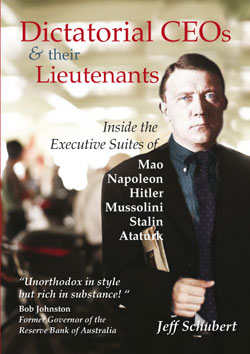
After I finished writing my book, “Dictatorial CEOs and their Lieutenants: Inside the Executive Suites of Mao, Napoleon, Hitler, Mussolini, Stalin, Ataturk”, I tried to interest a prominent Australian political commentator in it. He was dismissive, saying: “Hitler was a bad man and that’s all I need to know”. All too often, any comparison of a contemporary political figure with a Nazi figure is dismissed as inappropriate. This is generally due to the ignorance of many media people and so-called professional analysts of politics and international relations!
However, when interviewed by Joe Rogan, actor Russell Crowe presents a relatively intelligent and nuanced view of Hermann Goring – the Nazi leader he plays in the new film “Nuremberg”. Crowe also briefly comments of some of the positive aspects of Adolf Hitler’s life.
In the film, psychiatrist Douglas Kelley is challenged with determining if Hermann Goring is fit to stand trial at the Nuremberg trials. According to Crowe, “there’s a lot more to Goring than just looking at this and saying: “Oh, bad man, Nazi.” Goring is “an actual war hero” while Hitler – who was also a minor war hero — appealed to his strong patriotism. According to Crowe, Goring “goes into that political environment, that post-war environment, with a very definite belief in his country as being something special and he wants to make a contribution to lifting his country out of the mire that it’s currently in.”
I have not seen the film and will not attest to its accuracy, but I covered Goring quite extensively in my book. Here are some of the things that I wrote:
Once in power, Hitler continued to value Goring for his early 1920’s role in transforming the Nazi Party’s brown shirted SA, saying: “I gave him a dishevelled rabble. In a very short-time he had organised a division of eleven thousand men. He is the only one of its heads that ran the SA properly.” British Ambassador Sir Neville Henderson, who hunted game with Goering in the late 1930s, noted the role of Goring in Hitler’s rise to power and events up until the 1938 Anschluss: “Hitler’s brain might conceive the impossible, but Goring did it.”
Henderson summed up Goring as a “typical and brutal buccaneer”.
Goring was not intrinsically anti-Semetic – although this is not an issue covered in my book which is focussed on personal relationships at the highest executive level. Anti-Semetic acts by Goring were the result of his ambition and loyalty to Hitler. Interestingly, and perhaps ironically, Goring thought that ambition was also the driving force for Josef Goebbels, telling the prison psychiatrist at Nuremberg that Goebbels “saw his big chance to become powerful by using the press for anti-Semitic reasons. Personally, I think Goebbels was using anti-Semitism merely as a means of achieving personal power. Whether he had any deep-seated hatred against the Jews is questionable. I think he was too much of a thief and dishonest opportunist to have any deep-seated feelings for or against anything.”
Goring was to a considerable degree under Hitler’s spell, later saying: “If Hitler told you were a woman, you would leave the building believing that you were”. He once told Schmidt, the interpreter, of the difficulties he faced in disagreeing with Hitler: “I often make up my mind to say something to him, but then I come face to face with him and my heart sinks into my boots.”
Goring had a great desire to please Hitler. Luftwaffe Marshal Milch later claimed that Goring had said to him: “The Fuhrer will only ever ask me how many bombers do you have? He will never ask me how big they are. For one four-engined job I can build two and a half medium bombers.” Albert Speer wrote that in 1933 Goring asked him to remodel his house because Hitler had commented adversely on Goring’s own efforts: “Dark! How can anyone live in such darkness! Compare this with my professor’s (i.e. Speer’s) work. Everything bright, clear and simple!” Goring “immediately repudiated the decorative scheme he had just completed” and sought Speer’s help: “I can’t stand it myself. Do it anyway you like. I’m giving you a free hand; only it must turn out like the Fuhrer’s place.” After Speer had remodelled his house, Goring “never tired of telling Hitler how bright and expansive his home was now, ‘just like yours, my Fuhrer’.”
When Luftwaffe General Kammhuber objected to Goering’s order to transfer half of his aircraft to the eastern front against Russia, saying that he did not have enough planes to combat the RAF bombers (flying from the west) as it was, Goring angrily said to him: “Look, Kammhuber, I do not want this war against Russia. I am the one who is against it. So far as I am concerned, it is the worst possible thing we could do. I have argued against it until I am blue in the face, but they won’t listen. Now I am washing my hands of the whole business – the whole war. Do what you can. Get half of your fighters transferred. I just can’t be bothered about what happens anymore!”
Hitler was not unaware of Goering’s lack of enthusiasm and often rebuked him. Below, one of Hitler’s military aides, wrote that he “had often been present” when Hitler had given Goring a “sharp rebuke”. “When I told Hitler that I could not reconcile this sort of thing with his positive judgement of Goring, he replied that he had to be sharp with him occasionally because the Reichmarshal (Goring) was inclined to issue orders without bothering to ensure that they were carried out.”
Goring, for all his proven ability and ruthlessness, remained dependent on Hitler. Below wrote that “Goring was often wounded deeply by these criticisms. Once he confessed to me, “Hitler treats me like a stupid boy’ – and that was just how he looked when Hitler gave him a telling off.”
When discussing the attack on Russia with Goring, Hitler said: “I refused to see you, Goring, because I knew you would do all you could to talk me out of it.” As Goring once told British Ambassador Henderson: “When a decision has to be taken, none of us count more than the stones on which we are standing. It is the Fuhrer alone who decides.”
Goring was Hitler’s most influential lieutenant until he opposed the June 1941 invasion of Russia (although Crowe in his interview with Rogan seems to imply that Goring’s drug addictions were the main reason for his declining influence). Thereafter, as events unfolded much as he feared, Goring was a disinterested and largely ineffective lieutenant.
However, Hitler was loath to criticise Goring, let alone sack him, because he was still useful. As one of the most admired and likeable faces of the Nazi regime his authority was, as Hitler later told Goebbels, “indispensable to the supreme leadership of the Reich”. Hitler’s dim view of Goring’s performance only intensified and he was gradually, if mostly informally, stripped of his power. Nevertheless, Hitler found it difficult to totally gave up on Goring. Some months after the 20 July 1944 attempt on Hitler’s life, he visited an ill Below – his military aide who was suffering complications from wounds he received from the bomb – and spoke to him “about Goring’s faults”. Below later wrote: “He would not let Goring fall, however: his achievements were unique and it might be that he would need him again one day. It was clear to him that Goring had failed with the Luftwaffe, not least because of his idleness and partiality towards old cronies. But when it really mattered, Hitler said, he would want Goring at his side.” Only in his last days of the Nazi regime did Hitler finally sack Goring as his designated successor.
The cunning Goring – who surprised the Swedish businessman, Dahlerus, with his “strictly formal and obsequious behaviour” toward Hitler during a meeting – had his own direct and simple method of impressing Hitler. According to Albert Speer, Goring would not immediately arrive at many a military situation conference. Instead: “General Bodenschatz, his liaison officer to Hitler, left the situation conference in order to brief Goring — so we suspected on certain disputed questions! Fifteen minutes later, Goring would enter the situation conference. Of his own accord he would emphatically advocate exactly the viewpoint that Hitler wished to put across against the opposition of his generals. Hitler would then look around at his entourage: ‘You see, the Reich Marshal (Goring) holds exactly the same opinion as I do.’”
Only a few months before Germany’s defeat, Speer went to see Goring seeking some indication of support for his own efforts to tear himself from Hitler and from Hitler’s plans for the destruction of German industry. Despite having been made, in Speer’s words, “the scapegoat for all the failures of the Luftwaffe”, and the “most violent and insulting language” that Hitler used against him both at military situation conferences and behind closed doors, Goring could do no more that indicate a sense of disappointment with Hitler. Speer recalled Goring saying “it was easier for me, since I had joined Hitler a good deal later and could free myself from him all the sooner. He, Goring, had much closer ties with Hitler; many years of common experiences and struggles had bound them together – and he could no longer break loose.”
Goring was like a pig in mud with the possibilities of his position. The fanfare accompanying his 1935 marriage led the British Ambassador to comment: “A visitor to Berlin might well have thought that the monarchy had been restored and that he had stumbled upon the preparations for a royal wedding.” In late 1942 Goring journeyed to Italy with Field-Marshal Rommel, ostensibly to help co-ordinate operations in North Africa where the German and Italian forces were under pressure. However, Goering showed little interest in the task at hand. Instead, he went shopping for art works, flaunted his diamond ring – “one of the most valuable stones in the world” – and bragged to Rommel: “They call me the Maecenas of the Third Reich.” Following the defeat of France, Hitler dished out a round of promotions, with Goring promoted from Field-Marshal to Reich Marshal of the Greater German Reich (a six-star general). The American journalist, William Shirer, noted that Goring “acted like a happy child playing with his toys on Christmas morning”.
Goring, who had generally lost interest in the war effort – because it was a war he had argued against and did not believe could be won – had on one occasion been stirred up by Speer and showed interest in joining Goebbels, Speer and others in reining-in the influence of Martin Bormann and the remainder of the “headquarters clique” which included Field Marshal Keitel and the Chancellery Chief-of- Staff, Lammers. Goring, knowing that these three were entirely subservient to Hitler, was even somewhat dismissive: “Bormann and Keitel are nothing but the Fuhrer’s secretaries, after all. As far as their own powers are concerned, they’re nobodies.”
Goring did, however, have some concern that “Bormann was aiming at nothing less than the succession to Hitler, and that he would stop at nothing to outmanoeuvre him (Goring)” as the designated successor. Speer, Goebbels, Goring and a number of others decided to use a meeting on labour force mobilisation to begin the process of undermining Bormann, Keitel and Lammers. But, for Speer, things went wrong from the start. Goebbels didn’t turn up to the 12 April 1943 meeting and Goring changed sides; as though he “had picked up the wrong phonograph record”.
Speer and the others had been deserted and were nonplussed. Speer later wrote that Goebbels may have reported in “ill” because he “had an instinct for what was about to happen”. Not only had Goring changed sides, but 12 April was the day that Bormann became, officially at least, even more powerful. He was appointed “Secretary to the Fuhrer” in addition to his official Nazi Party position and authorised, according to Speer, “to act officially in any field he wished”. Bormann himself informed everyone: “For years, as you know, I have almost daily been given assignments outside the range of the Party Chancellery’s duties”; and that the appointment “does not mean that a new office with a new set of duties has been created”. While it meant little change in what Bormann actually did, the new title meant that Bormann was clearly in Hitler’s good books. Hitler said: “In order to win the war, I need Bormann. Anyone who is against Bormann is against the state.”
This would have been enough for Goebbels to suck-up to Bormann. As for Goring, Speer later wrote: “Our attempt to mobilise Goring against Bormann was probably doomed to failure from the start for financial reasons as well. For as was later revealed by a Nuremberg document, Bormann had made Goring a gift of six million marks from the industrialists’ Adolf Hitler Fund.” Bormann and Goebbels now came to “an arrangement – Goebbels promising to direct reports to Hitler through Bormann, in return for Bormann’s extracting the right sort of decision from Hitler.”
Goring later summed up the evolution of his own relationship with Hitler: “To me there are two Hitlers: one who existed until the end of the French war; the other begins with the Russian campaign. In the beginning he was genial and pleasant. He would have extraordinary will-power and unheard-of influence on people. He had much charm and goodwill. He was always frank. The second Hitler was always suspicious, easily upset, and tense. He was distrustful to an extreme degree.”
In summary, Russel Crowe (and the film’s makers) have done a considerable positive service in strongly and intelligently pointing out that there are almost no characters in history that were totally “good” or “bad” – just as is the case in the contemporary world!
My book, “Dictatorial CEOs and their Lieutenants: Inside the Executive Suites of Mao, Napoleon, Hitler, Mussolini, Stalin, Ataturk” is available here: https://www.jeffschubert.com/