

Book
Blogs
- Adolf Hitler learns about AI
- Why do many people support Donald Trump?
- Iran Conference, 14 July 2026
- Victim impact statements are much abused
- Psychological Ability to Deceive!
- Trump is doing in Iran what Putin did in Ukraine”, says former head of British spy agency M16
- Trump officials asked: “Why Australian Jews aren’t carrying guns”
- Iran’s military defeat could echoe the 1920s-30s in Germany and Russia in the 1990s and early 2000s.
- AFR article about Greg Moriarty
- Jo Tarnawsky on Richard Marles USA Obsession!
- Muslims Should Not Trust Australian Courts!
- Why ICE agents continue shooting & shooting!
- Appointment of Greg Moriarty as Ambassador to the USA will damage Australia’s national security.
- Trump will Not give up Power – A Scenario!
- Cognitive blind spots
- AUKUS and Kim Jong Un
- David Gonski and Chris Minns
- Video on secret origins of AUKUS
- Peter Jennings would thrive in an authoritarian country.
- David Leser, a Jewish author & journalist, wrote:
- My 31 year Russian Saga
- Actor Russell Crowe: Hermaan Goring in Nuremberg
- “Foreign Affairs” magazine nonsense on AUKUS
- How China Can Succeed in Taking Control of Taiwan Under Trump!
- Trump Psychology and Capability compared to Famous Dictators
- Video of Putin’s Psychology and Leadership Style
- Trump’s Security Adviser Stephen Miller & Himmler-Bormann
- Video (and Text) comparing Putin’s rise and consolidation of power to other historical dictators
- ASIO chief Mike Burgess would be happy working for Putin
- Australia’s Racist NSW Police
- Trump’s Odessa for Greenland deal!
- Confidential Letter to Trump on AUKUS
- Why Do People Serve a Donald Trump and Vladimir Putin?
- Trump Psychology and Capability compared to Famous Dictators
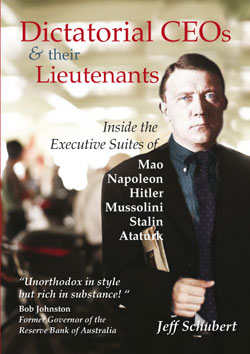
- Putin and his Lieutenants compared to Mao, Napoleon, Hitler, Mussolini, Stalin and Ataturk
- Russian Censorship Comes to Australia via Jews!
- Anne Applebaum writes like Trump talks
- Putin’s Successor if he is killed soon!
- Brittany Higgins false rape earned her $2m
- Lies of Mike Burgess, the Director General of ASIO
- Beazley, Richardson, Dibb are old men pushing sexy, ignorant group thinks.
- Jewish women Yvonne Engelman and Nina Bassat are Russia-type PR pawns?
- Bad News for Ukraine
- Group Think psychology of AUKUS and Option 2
- Putin says he follows Israeli Gaza example
- Henry Ergas praises Nazi “Will”
- What did we learn from the Tucker Carlson interview of Putin?
- Russian-Ukraine lessons on China
- Me and Colin Rubenstein – an Australian “traitor”?
- Cardinal Pell and David McBride
- Air Chief Marshal Houston & Hitler
- Albrechtsen plagiarises Goebbels
- Anatoly Chubais
- Assange and Defence
- Blair & Gadhafi
- Blair & Napoleon
- Brooks and Tett on policy psychology
- Cardinal Pell’s God
- Donald Rumsfeld
- Field-Marshal Keitel
- George Bush, Stalin, Mao
- Gillard & Duncan Lewis
- Gillard & Obama
- Gillard & Putin
- Gillard: psychological profile
- Gillard’s personal decision UN vote!
- Goering’s Wisdom
- History of anti-terrorist laws in dictatorships
- Howard & Sinodinos
- James Packer’s lieutenants
- Lateral Thinking
- Lawyer X, Huawei, National Security, Scott Morrison, Chinese in Australia!
- Major-General Cantwell & Matiullah Khan
- Medvedev & Obama
- Medvedev & Putin: “power corrupts”
- Morrison, Binskin and Napoleon
- National Security Myth
- Obama, Jefferson, slaves, murder, Nobel Prizes
- Obama’s Nobel Prize speech
- Paul Lodge (Family Court, Australia)
- Peta Credlin and Abbott, like Hitler-Bormann
- Peter FitzSimmons, George Pell, bias and group think.
- Psychologies of Putin and USA
- Psychology of Secret Courts / Military Tribunals
- Psychology of Supporters of Bush & Saddam
- Putin in 2000
- Putin Personality Cult
- Putin, Gillard, Abbott, Medvedev
- Putin: New Faces and Flaws in the Weave
- Putin’s dangerous reading
- Russia, NATO, Missile Defence
- Tony Abbott
- US Missile Defence
- Wendi (Wendy) Deng
- Why I support WikiLeaks
- Movie Script: Russia to Cambodia
Personal Links
"Foreign Affairs" magazine nonsense on AUKUS
On 2 September “Foreign Affairs” magazine published an article entitled “Don’t Abandon AUKUS
The Case for Recommitting to — and Revitalizing –– the Alliance” which revealed the ignorance of its authors which included James Mattis, the formerly US Secretary of Defense. The article is essentially a word salad that completely ignored the issue of whether it is possible for AUKUS (Australia-UK-US) nuclear submarines to be built in Adelaide – the capital city of South Australia with a population of 1.5 million people and a limited range of industrial activities situated far from any major manufacturing center. Adelaide is the chosen AUKUS nuclear submarine site because it was the politically chosen place to build Australia’s 6 diesel-electric Collins-class submarines between 1990 and 2003.
This crucial issue of Adelaide capability to build AUKUS submarines is generally ignored in discussions of AUKUS because most political pundits are uncomfortable with industrial economics and management. But it is the focus of this article. The head of the secretive Australian Submarine Agency, which is responsible for constructing the AUKUS submarines, has suggested that these submarines will be capable of many diverse activities and will weigh between 10,000 and 12,000 tones — compared with 7,000 tons for present-day US nuclear submarines and 3,000 tonnes for the Collins-class!
Despite extensive questioning and research I have not been able to identify even one “independent” expert who believes that AUKUS nuclear submarines can be built in Adelaide. By “independent” I mean not having a financial, career or political interest in the issue. Too many of the AUKUS advocates have a “interest” – disclosed or hidden — in AUKUS proceeding.
I am certainly not an expert on building submarines but have a long-standing interest. After graduating with degrees in economics and history I began my full-time working career as a junior executive in two large Adelaide manufacturing companies (agricultural machinery and tyres). In subsequent years I worked mainly focused on financial issues in Australia and China but also spent years in Russia examining Russian companies and teaching international business management to Chinese students. In this latter role I made sure that I was able to talk about a whole range of advanced business management issues.
I am not the only person very skeptical of building AUKUS nuclear submarines in Adelaide. Alexander Downer, the former Australian Foreign Minister (and strong supporter of the Australia-US alliance) who comes from Adelaide and still lives there, has publicly described it as a “fairy tale”, as has Hans J. Ohff who headed the building of the Collin-class submarines. The British journalist and military historian Max Hastings reported that “a British defense insider” said to him: “I don’t think our UK submarine sector is remotely capable of delivering what the Australians want on time, on cost or to standard.”
Ted Goranson, a former builder of US nuclear submarines now living in Australia, is also highly skeptical. See his blog: https://www.linkedin.com/pulse/submarine-complexity-ted-goranson-rcdcc/?trackingId=0rj245Ysin3Bm%2Br1tqk9rg%3D%3D
In addition to Mattis, the authors of the Foreign Affairs article include Gary Roughead, a former Chief of US Naval Operations and Nicholas Carter, a former Chief of US Defence Staff. These are all people with experience using defence assets – but not building complicated machines like nuclear submarines. The fourth author is Marise Payne, a former Australian Minister of Foreign Affairs and Defence, who – it has to be said – never said or wrote anything notable in either of these posts.
The lack of attention to Adelaide in the Foreign Affairs article reflects, in part, the authors lack of familiarity with industrial activity but also a fear of stepping into such a world. Thus, best ignore it!
Instead, the authors say the “AUKUS partners must establish a more decisive leadership and coordination model. Vesting oversight primarily in defense departments and ministries is a traditional inclination. But the scope of AUKUS –– particularly regarding dual-use emerging technologies — means that the leadership of AUKUS should come from a consortium of defense, foreign, and commerce departments or ministries. The leader of each country’s delegation should be deemed an ambassador, or have a title and organizational stature commensurate with the scope and complexity of the endeavor. Such leaders must possess the authority necessary to effectively coordinate and, when required, compel action. AUKUS should be further managed by a trilateral secretariat staffed with requisite experience and competence from relevant organizations and industries, as a counterweight to the tendencies of parochialism and bureaucratic insularity”.
This is unrealistic management and political lunacy and it is a surprise that Foreign Affairs published it. Rex Patrick, a former South Australian Senator and submarine crewman with industry experience, has accurately written that “senior military officers (excluding Payne) who were no doubt great war fighters in their junior years but with little project management experience, have been making high-risk purchase recommendations to Cabinet ministers with zero project management experience”.