

Book
Blogs
- Iran’s military defeat could echoe the 1920s-30s in Germany and Russia in the 1990s and early 2000s.
- AFR article about Greg Moriarty
- Jo Tarnawsky on Richard Marles USA Obsession!
- Muslims Should Not Trust Australian Courts!
- Why ICE agents continue shooting & shooting!
- Appointment of Greg Moriarty as Ambassador to the USA will damage Australia’s national security.
- Trump will Not give up Power – A Scenario!
- Cognitive blind spots
- AUKUS and Kim Jong Un
- David Gonski and Chris Minns
- Video on secret origins of AUKUS
- Peter Jennings would thrive in an authoritarian country.
- David Leser, a Jewish author & journalist, wrote:
- My 31 year Russian Saga
- Actor Russell Crowe: Hermaan Goring in Nuremberg
- “Foreign Affairs” magazine nonsense on AUKUS
- How China Can Succeed in Taking Control of Taiwan Under Trump!
- Trump Psychology and Capability compared to Famous Dictators
- Video of Putin’s Psychology and Leadership Style
- Trump’s Security Adviser Stephen Miller & Himmler-Bormann
- Video (and Text) comparing Putin’s rise and consolidation of power to other historical dictators
- ASIO chief Mike Burgess would be happy working for Putin
- Australia’s Racist NSW Police
- Trump’s Odessa for Greenland deal!
- Confidential Letter to Trump on AUKUS
- Why Do People Serve a Donald Trump and Vladimir Putin?
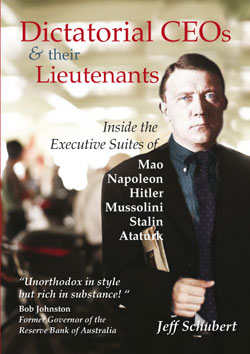
- Putin and his Lieutenants compared to Mao, Napoleon, Hitler, Mussolini, Stalin and Ataturk
- Russian Censorship Comes to Australia via Jews!
- Anne Applebaum writes like Trump talks
- Putin’s Successor if he is killed soon!
- Brittany Higgins false rape earned her $2m
- Lies of Mike Burgess, the Director General of ASIO
- Beazley, Richardson, Dibb are old men pushing sexy, ignorant group thinks.
- Jewish women Yvonne Engelman and Nina Bassat are Russia-type PR pawns?
- Bad News for Ukraine
- Group Think psychology of AUKUS and Option 2
- Putin says he follows Israeli Gaza example
- Henry Ergas praises Nazi “Will”
- What did we learn from the Tucker Carlson interview of Putin?
- Russian-Ukraine lessons on China
- Me and Colin Rubenstein – an Australian “traitor”?
- Cardinal Pell and David McBride
- Air Chief Marshal Houston & Hitler
- Albrechtsen plagiarises Goebbels
- Anatoly Chubais
- Assange and Defence
- Blair & Gadhafi
- Blair & Napoleon
- Brooks and Tett on policy psychology
- Cardinal Pell’s God
- Donald Rumsfeld
- Field-Marshal Keitel
- George Bush, Stalin, Mao
- Gillard & Duncan Lewis
- Gillard & Obama
- Gillard & Putin
- Gillard: psychological profile
- Gillard’s personal decision UN vote!
- Goering’s Wisdom
- History of anti-terrorist laws in dictatorships
- Howard & Sinodinos
- James Packer’s lieutenants
- Lateral Thinking
- Lawyer X, Huawei, National Security, Scott Morrison, Chinese in Australia!
- Major-General Cantwell & Matiullah Khan
- Medvedev & Obama
- Medvedev & Putin: “power corrupts”
- Morrison, Binskin and Napoleon
- National Security Myth
- Obama, Jefferson, slaves, murder, Nobel Prizes
- Obama’s Nobel Prize speech
- Paul Lodge (Family Court, Australia)
- Peta Credlin and Abbott, like Hitler-Bormann
- Peter FitzSimmons, George Pell, bias and group think.
- Psychologies of Putin and USA
- Psychology of Secret Courts / Military Tribunals
- Psychology of Supporters of Bush & Saddam
- Putin in 2000
- Putin Personality Cult
- Putin, Gillard, Abbott, Medvedev
- Putin: New Faces and Flaws in the Weave
- Putin’s dangerous reading
- Russia, NATO, Missile Defence
- Tony Abbott
- US Missile Defence
- Wendi (Wendy) Deng
- Why I support WikiLeaks
- Movie Script: Russia to Cambodia
- Trump Psychology and Capability compared to Famous Dictators
Personal Links
AFR article about Greg Moriarty
AFR has an article about Greg Moriarty by Michael Read, “Why Canberra has chosen this man to take over from Kevin Rudd”, in which many people extol Moriarty virtues.
The one exception is Michael Shoebridge, who says:
“He has been unwilling to bring the government to make the hard decisions. How can we have the government saying defence procurement is in such a mess that it needs the biggest shake-up in decades and the head of the department is an unalloyed high achiever? The two things don’t fit.” Shoebridge says Moriarty “has presided over the defence department for long enough to be fully accountable for its problems, and yet he seems to have escaped scot-free”. “He’s a bureaucrat who has done what his political masters directed at every stage of his career and has been rewarded for that.”
A public service colleague speaking on the condition of anonymity said there was a recent history of department’s bosses who excelled at policy and strategy but not at project delivery. “Greg is not a program guy,” they said. “He’s a superb geopolitical guy. But that’s not the same as when the minister says I need 100 missiles by Friday. He would understand why we’d need 100 missiles. He would be superb on the policy question of why we need 100 missiles by Friday. But he’s not the guy to push people hard, partly because of his character.”
In my varied career — Australia, Russia, China — in public service, business and academia, I have often come across people who confidently advocate some exceptional strategy but, when pressed, cannot clearly explain how it would work in practice. Examples include the role of monetary aggregates in Australian monetary policy, business taxation reform in the case of Tax Value Method (TVM), and IMF and “shock therapy” ideas for economic reform in Russia in the 1990s.
I understand that one individual cannot have a good understanding of all aspects of an issue. But, often the big strategy-type people just do not want to accept that there may be problems with their ideas. It makes them uncomfortable — so best to dismiss such problems as “details”.
More generally, invading Iraq and building a new society there is an example!
In my view, this is a problem with AUKUS and why Moriarty is a bad choice for Ambassador to the USA. He is an enthusiastic advocate with little idea of the difficulties of practical application — particularly building nuclear submarines in Adelaide!